

WEF: Themes - Human Resources
14.09.10 How to Become a Global Player
14.09.10 Creating Intrapreneurs
13.09.10 Asia's Workforce: The Female Factor
13.09.10 Developing Natural Resources to Build Human Resources
17.05.10 Emerging Market Multinationals: Building the New Fortune 500
11.05.10 Competition and Regulation: Rethinking the European Response
10.05.10 Europe: A World Leader in Renewable Technology?
07.05.10 India-Africa Partnership: Gateway for Innovation Transfer and Investment
06.05.10 Higher Education for Africa
28.01.10 New Corporate Governance in the Post-Crisis World
28.01.10 Rethinking Leadership Development
27.01.10 Management Innovations from the Fringe
13.11.09 A Roadmap for India's Next Generation of Growth
10.11.09 How Can India Become a Global Manufacturing Hub?
09.11.09 Creating World-Class Education in India
09.11.09 India's Next Aspiration
08.11.09 Economic Update: India's Outlook
16.09.09 IdeasLab with Social Entrepreneurs
11.09.09 Redesigning Corporate Governance
10.06.09 Africa Brainstorming: Changes, Challenges and Opportunities
15.05.09 Global Redesign Series: The Middle East G20 Imperative
30.01.09 Advice to the US President on Competitiveness
29.01.09 Live Long and Prosper
18.11.08 Reforming India's Healthcare System
18.11.08 A Skills Shortage after the Brain Drain?
18.11.08 From Imitator to Innovator: Globalization of Healthcare and Life Sciences
16.11.08 Catalysing a Turnaround for the Global Economy
16.11.08 The Dichotomy of Success: Chronic Disease and Malnutrition in India
28.09.08 Market Insight: Russia
16.06.08 The Myths and Realities of the R&D Advantage
05.06.08 Corporate Global Citizenship - One Size Does Not Fit All
20.05.08 Scenarios Series Conclusion: What Can We Learn from the Future?
19.05.08 Eye on Algeria
19.05.08 Eye on Kazakhstan
19.05.08 Scenarios Series: Managing Mobile Talent
15.04.08 Addressing the Entry-level Skills Gap in Education
26.01.08 Death, Disease and Dirty Water
04.12.07 India's Demographic Dividend: How Will It Really Pay Out?
06.09.07 The Transformative Potential of Science and Technology in Asia
25.06.07 Maintaining Hyper-growth: Is There an Asian Way?
14.06.07 Rethinking Growth
14.06.07 African Urbanization: Making Room for the Boom
14.06.07 Unlocking the Potential: Building Capacity for the Future
19.05.07 Tourism Competitiveness: Taking Flight?
27.01.07 Managing Hyper-growth Corporations
27.01.07 New Blood for Industrialized Societies
27.01.07 The Price of Becoming Old
27.01.07 Strategies for a New Power Equation
27.01.07 Delivering on the Promise of Africa
25.01.07 Future Series: Building the Skills of Tomorrow
1 2 3 [next]
14.09.10 Creating Intrapreneurs
13.09.10 Asia's Workforce: The Female Factor
13.09.10 Developing Natural Resources to Build Human Resources
17.05.10 Emerging Market Multinationals: Building the New Fortune 500
11.05.10 Competition and Regulation: Rethinking the European Response
10.05.10 Europe: A World Leader in Renewable Technology?
07.05.10 India-Africa Partnership: Gateway for Innovation Transfer and Investment
06.05.10 Higher Education for Africa
28.01.10 New Corporate Governance in the Post-Crisis World
28.01.10 Rethinking Leadership Development
27.01.10 Management Innovations from the Fringe
13.11.09 A Roadmap for India's Next Generation of Growth
10.11.09 How Can India Become a Global Manufacturing Hub?
09.11.09 Creating World-Class Education in India
09.11.09 India's Next Aspiration
08.11.09 Economic Update: India's Outlook
16.09.09 IdeasLab with Social Entrepreneurs
11.09.09 Redesigning Corporate Governance
10.06.09 Africa Brainstorming: Changes, Challenges and Opportunities
15.05.09 Global Redesign Series: The Middle East G20 Imperative
30.01.09 Advice to the US President on Competitiveness
29.01.09 Live Long and Prosper
18.11.08 Reforming India's Healthcare System
18.11.08 A Skills Shortage after the Brain Drain?
18.11.08 From Imitator to Innovator: Globalization of Healthcare and Life Sciences
16.11.08 Catalysing a Turnaround for the Global Economy
16.11.08 The Dichotomy of Success: Chronic Disease and Malnutrition in India
28.09.08 Market Insight: Russia
16.06.08 The Myths and Realities of the R&D Advantage
05.06.08 Corporate Global Citizenship - One Size Does Not Fit All
20.05.08 Scenarios Series Conclusion: What Can We Learn from the Future?
19.05.08 Eye on Algeria
19.05.08 Eye on Kazakhstan
19.05.08 Scenarios Series: Managing Mobile Talent
15.04.08 Addressing the Entry-level Skills Gap in Education
26.01.08 Death, Disease and Dirty Water
04.12.07 India's Demographic Dividend: How Will It Really Pay Out?
06.09.07 The Transformative Potential of Science and Technology in Asia
25.06.07 Maintaining Hyper-growth: Is There an Asian Way?
14.06.07 Rethinking Growth
14.06.07 African Urbanization: Making Room for the Boom
14.06.07 Unlocking the Potential: Building Capacity for the Future
19.05.07 Tourism Competitiveness: Taking Flight?
27.01.07 Managing Hyper-growth Corporations
27.01.07 New Blood for Industrialized Societies
27.01.07 The Price of Becoming Old
27.01.07 Strategies for a New Power Equation
27.01.07 Delivering on the Promise of Africa
25.01.07 Future Series: Building the Skills of Tomorrow
1 2 3 [next]
WEF: Themes - E-commerce
WEF: Themes - Corporate Governance
13.09.10 Managing across Cultures
06.06.10 Tackling Corruption, Enhancing Competitiveness
30.01.10 Financial Risk Management 2.0?
29.01.10 Women Leaders Dinner: Identifying Your Identity
28.01.10 New Corporate Governance in the Post-Crisis World
27.01.10 Rethinking Risk in the Boardroom
09.11.09 Financial Aftershock: Resuscitating the Flow of Private Capital
11.09.09 Redesigning Corporate Governance
18.06.09 Shaping the New Values of Capitalism
16.05.09 Global Redesign Series: The Post-crisis Regulatory Environment
15.05.09 Global Agenda Council Update: Corporate Governance
15.04.09 Financing Growth and Development in Adverse Conditions
30.01.09 Global Industry Outlook 2
28.09.08 Market Insight: Russia
27.09.08 New Entrepreneurship, Chinese-style
16.06.08 Corporate Global Citizenship: Its Future Role in Asia
19.05.08 Eye on Pakistan
27.01.08 Message from Davos: Believing in the Future
26.01.08 The DNA of Effective Boards
03.12.07 Building a Global Financial Centre in India
07.09.07 Growth Hotspots -- Focus on India
15.06.07 Africa and Asia: Creating a New Axis of Partnership
14.06.07 Avoiding a Race to the Bottom
27.01.07 Is Bigger Better in Private Equity?
26.01.07 In China, Does Big Equate to World Beater?
25.01.07 What's on the Mind of Asia's New Business Giants?
23.11.06 FDI: The Colour of Money
11.09.06 Sino-US Relations: Same Bed, Different Dreams?
11.09.06 Capital Markets in China: What Happened to the Take-off?
01.06.06 New Partnerships: How Will China and India Transform Africa?
31.05.06 Graduating Top Talent
22.05.06 Funding the Future?
21.05.06 Davos WorkSpace - Challenges in the Evolution of Capital Markets
20.05.06 Opening Plenary Session
20.05.06 Davos WorkSpace - Looking for the Next Big Idea
06.04.06 Opportunities for New Financial Actors
26.01.06 China Goes Global
26.01.06 Breakthrough Ideas for 2006: Doubt and Decision-making
10.09.05 China's Capital Markets: Where Are the Investors?
09.09.05 Ask the Venture Capitalist: Nurturing the Early Stage Investment Climate in China
29.01.05 Is Responsible Investment About to Pay Off?
07.12.04 Sooner Not Later: Indian Multinationals in the Fortune 500
06.12.04 Effective Governance: India?s Other Challenge
13.09.04 Understanding the Dynamics of Change in China: What's the Next Big Thing?
12.09.04 Economic Outlook: Moving towards a Market Economy
12.09.04 SOE Reform: An Update
12.09.04 Corporate Governance: From Scandal to Sustainability
12.09.04 The Credit Crunch: How Deep an Impact?
16.05.04 Leading with the Example: Governance Reform
30.04.04 Transatlantic Relations: A New Direction
1 2 [next]
06.06.10 Tackling Corruption, Enhancing Competitiveness
30.01.10 Financial Risk Management 2.0?
29.01.10 Women Leaders Dinner: Identifying Your Identity
28.01.10 New Corporate Governance in the Post-Crisis World
27.01.10 Rethinking Risk in the Boardroom
09.11.09 Financial Aftershock: Resuscitating the Flow of Private Capital
11.09.09 Redesigning Corporate Governance
18.06.09 Shaping the New Values of Capitalism
16.05.09 Global Redesign Series: The Post-crisis Regulatory Environment
15.05.09 Global Agenda Council Update: Corporate Governance
15.04.09 Financing Growth and Development in Adverse Conditions
30.01.09 Global Industry Outlook 2
28.09.08 Market Insight: Russia
27.09.08 New Entrepreneurship, Chinese-style
16.06.08 Corporate Global Citizenship: Its Future Role in Asia
19.05.08 Eye on Pakistan
27.01.08 Message from Davos: Believing in the Future
26.01.08 The DNA of Effective Boards
03.12.07 Building a Global Financial Centre in India
07.09.07 Growth Hotspots -- Focus on India
15.06.07 Africa and Asia: Creating a New Axis of Partnership
14.06.07 Avoiding a Race to the Bottom
27.01.07 Is Bigger Better in Private Equity?
26.01.07 In China, Does Big Equate to World Beater?
25.01.07 What's on the Mind of Asia's New Business Giants?
23.11.06 FDI: The Colour of Money
11.09.06 Sino-US Relations: Same Bed, Different Dreams?
11.09.06 Capital Markets in China: What Happened to the Take-off?
01.06.06 New Partnerships: How Will China and India Transform Africa?
31.05.06 Graduating Top Talent
22.05.06 Funding the Future?
21.05.06 Davos WorkSpace - Challenges in the Evolution of Capital Markets
20.05.06 Opening Plenary Session
20.05.06 Davos WorkSpace - Looking for the Next Big Idea
06.04.06 Opportunities for New Financial Actors
26.01.06 China Goes Global
26.01.06 Breakthrough Ideas for 2006: Doubt and Decision-making
10.09.05 China's Capital Markets: Where Are the Investors?
09.09.05 Ask the Venture Capitalist: Nurturing the Early Stage Investment Climate in China
29.01.05 Is Responsible Investment About to Pay Off?
07.12.04 Sooner Not Later: Indian Multinationals in the Fortune 500
06.12.04 Effective Governance: India?s Other Challenge
13.09.04 Understanding the Dynamics of Change in China: What's the Next Big Thing?
12.09.04 Economic Outlook: Moving towards a Market Economy
12.09.04 SOE Reform: An Update
12.09.04 Corporate Governance: From Scandal to Sustainability
12.09.04 The Credit Crunch: How Deep an Impact?
16.05.04 Leading with the Example: Governance Reform
30.04.04 Transatlantic Relations: A New Direction
1 2 [next]
WEF: Themes - Business Strategy
15.09.10 Small Is Beautiful
13.09.10 The Emerging New Consumer
16.09.09 IdeasLab with Social Entrepreneurs
12.09.09 The Power of Positive Deviance
15.04.09 Will Technology Help Business Navigate in an Economic Downturn?
28.09.08 From Global Growth Company to Corporate Global Citizen
25.01.08 Local Innovation for Global Impact
25.06.07 China Plus One: Where Is the Safe Investment Bet? - GGC
26.04.07 Business Strategies in Climate Change
28.01.06 Beyond Short-termism: Not on My Watch
27.01.06 Digital 2.0: Powering a Creative Economy
26.01.06 Executing Business Strategies
27.01.05 How to Tap the Bottom of the Pyramid
15.05.04 Middle East Economies Update
22.01.04 Open Source Goes Mainstream
22.01.04 Leveraging Technology for the Bottom Line
28.01.03 Identifying Our Priorities: Key Messages from the Annual Meeting 2003
28.01.03 Applying Our Priorities to Business Strategy: A Brainstorming Session
25.01.03 Trade in Asia: The Business View
13.09.10 The Emerging New Consumer
16.09.09 IdeasLab with Social Entrepreneurs
12.09.09 The Power of Positive Deviance
15.04.09 Will Technology Help Business Navigate in an Economic Downturn?
28.09.08 From Global Growth Company to Corporate Global Citizen
25.01.08 Local Innovation for Global Impact
25.06.07 China Plus One: Where Is the Safe Investment Bet? - GGC
26.04.07 Business Strategies in Climate Change
28.01.06 Beyond Short-termism: Not on My Watch
27.01.06 Digital 2.0: Powering a Creative Economy
26.01.06 Executing Business Strategies
27.01.05 How to Tap the Bottom of the Pyramid
15.05.04 Middle East Economies Update
22.01.04 Open Source Goes Mainstream
22.01.04 Leveraging Technology for the Bottom Line
28.01.03 Identifying Our Priorities: Key Messages from the Annual Meeting 2003
28.01.03 Applying Our Priorities to Business Strategy: A Brainstorming Session
25.01.03 Trade in Asia: The Business View
WEF: Themes - Business and Management
15.09.10 Corporate Citizenship: Why It Matters
15.09.10 WHAT IF: there is an emerging market crisis in 2011?
15.09.10 Looking into the Future: Predictive Models
14.09.10 Company Culture: A Key to Business Success
14.09.10 How to Become a Global Player
14.09.10 No Growth without Health
14.09.10 The Future of State-owned Enterprises
14.09.10 Looking into the Future: Mixed Reality
14.09.10 Ending the Trade Charade: Rethinking the Global Value Chain
14.09.10 Our Vision for How We Improve the State of the World by Serving Our Members and Constituents
14.09.10 Navigating through Troubled Waters
14.09.10 Creating Intrapreneurs
13.09.10 Reading Leaders' Minds
13.09.10 Asia's Workforce: The Female Factor
13.09.10 Managing across Cultures
13.09.10 The Emerging New Consumer
07.06.10 Emerging Green Collar Jobs and Green Entrepreneurship in Asia
06.06.10 When Asia's Youth Speaks, Is the Rest of the World Listening?
06.06.10 Countdown to Regional Integration
06.06.10 The Economic Redesign and Rebalance Imperative
02.06.10 Rebuild In Depth: Global Risks
02.06.10 Rebuild In Depth: Humanitarian Assistance and Fragile States
31.05.10 Rebuild In Depth: Low-Carbon Growth
31.05.10 Renovating the International System
11.05.10 Innovation, Green Technology and Growth: Pulling It Together
11.05.10 Rising from the Ashes: Redesigning European Crisis Management
11.05.10 Redesigning Europe's Competitiveness Strategy
07.05.10 Managing the Water-Food-Energy Nexus
07.05.10 A New Approach to Catalysing Africa's Trade Agenda
07.05.10 Produce Local, Trade Regional, Sell Global
06.05.10 Africa's Missing Middle
06.05.10 Africa's Destabilizing Factors
04.02.10 Entrepreneurship: The Key to Sustainable Growth
30.01.10 Connecting a Carbon- and Time-constrained World
30.01.10 Redesigning Financial Regulation
30.01.10 Weak Signals
30.01.10 IdeasLab with Young Global Leaders
30.01.10 IdeasLab with University of Pennsylvania and The Wharton School
30.01.10 The Gender Agenda: Putting Parity into Practice
29.01.10 Reinventing Management: The Challenge of Exponential Change
29.01.10 Negotiations: Overcoming the Challenges of Emotions and Culture
29.01.10 Wanted: Capital
29.01.10 Business Leadership for the 21st Century
29.01.10 Global Industry Outlook: Finance, Services and Media
29.01.10 The New Normal
29.01.10 IdeasLab on the Global Redesign Initiative (New Institutional Approaches)
29.01.10 Redesigning Capital Markets
29.01.10 Rebuilding the Grid
29.01.10 Achieving Social Goals: The Power of Behavioural Science
29.01.10 Creating Jobs and Strengthening Social Welfare
1 | 2 | 3 | 4 | 5 | 6 | 7 | 8 | 9 | 10 | 11 [next]
15.09.10 WHAT IF: there is an emerging market crisis in 2011?
15.09.10 Looking into the Future: Predictive Models
14.09.10 Company Culture: A Key to Business Success
14.09.10 How to Become a Global Player
14.09.10 No Growth without Health
14.09.10 The Future of State-owned Enterprises
14.09.10 Looking into the Future: Mixed Reality
14.09.10 Ending the Trade Charade: Rethinking the Global Value Chain
14.09.10 Our Vision for How We Improve the State of the World by Serving Our Members and Constituents
14.09.10 Navigating through Troubled Waters
14.09.10 Creating Intrapreneurs
13.09.10 Reading Leaders' Minds
13.09.10 Asia's Workforce: The Female Factor
13.09.10 Managing across Cultures
13.09.10 The Emerging New Consumer
07.06.10 Emerging Green Collar Jobs and Green Entrepreneurship in Asia
06.06.10 When Asia's Youth Speaks, Is the Rest of the World Listening?
06.06.10 Countdown to Regional Integration
06.06.10 The Economic Redesign and Rebalance Imperative
02.06.10 Rebuild In Depth: Global Risks
02.06.10 Rebuild In Depth: Humanitarian Assistance and Fragile States
31.05.10 Rebuild In Depth: Low-Carbon Growth
31.05.10 Renovating the International System
11.05.10 Innovation, Green Technology and Growth: Pulling It Together
11.05.10 Rising from the Ashes: Redesigning European Crisis Management
11.05.10 Redesigning Europe's Competitiveness Strategy
07.05.10 Managing the Water-Food-Energy Nexus
07.05.10 A New Approach to Catalysing Africa's Trade Agenda
07.05.10 Produce Local, Trade Regional, Sell Global
06.05.10 Africa's Missing Middle
06.05.10 Africa's Destabilizing Factors
04.02.10 Entrepreneurship: The Key to Sustainable Growth
30.01.10 Connecting a Carbon- and Time-constrained World
30.01.10 Redesigning Financial Regulation
30.01.10 Weak Signals
30.01.10 IdeasLab with Young Global Leaders
30.01.10 IdeasLab with University of Pennsylvania and The Wharton School
30.01.10 The Gender Agenda: Putting Parity into Practice
29.01.10 Reinventing Management: The Challenge of Exponential Change
29.01.10 Negotiations: Overcoming the Challenges of Emotions and Culture
29.01.10 Wanted: Capital
29.01.10 Business Leadership for the 21st Century
29.01.10 Global Industry Outlook: Finance, Services and Media
29.01.10 The New Normal
29.01.10 IdeasLab on the Global Redesign Initiative (New Institutional Approaches)
29.01.10 Redesigning Capital Markets
29.01.10 Rebuilding the Grid
29.01.10 Achieving Social Goals: The Power of Behavioural Science
29.01.10 Creating Jobs and Strengthening Social Welfare
1 | 2 | 3 | 4 | 5 | 6 | 7 | 8 | 9 | 10 | 11 [next]
WEF: Themes - Arts and Culture
31.05.10 Renovating the International System
07.05.10 New Models of Collaboration for Economic Development in Africa
06.05.10 Redesigning Africa's Capital Markets
05.05.10 Africa Brainstorming: Turning Vision into Reality
30.01.10 The Art of Musical Improvisation
28.01.10 Design for Change
28.01.10 Redesigning the International Monetary System
28.01.10 Reading Leaders' Minds
17.09.09 IdeasLab with Keio University: Digital Media and the Internet
12.09.09 Great Books for a Globalized World
10.09.09 Defining "Green" in Business
19.06.09 Setting Asia's Green Growth Agenda
11.06.09 The Future of South Africa
10.06.09 Africa and the New Global Economy
17.05.09 The Story from Dubai
15.05.09 Unconventional Capitalism
15.04.09 Regional Economic Update 2009
15.04.09 Financing Growth and Development in Adverse Conditions
01.02.09 A Roadmap Out of the Economic Crisis
29.01.09 The Middle East: Owning Its Challenges
18.11.08 Unlocking the Economic Synergies in South Asia
18.11.08 Big Bets on Technology and Manufacturing
16.11.08 The Future of India's Cyberculture
16.11.08 Ideas for Securing India's Promise
03.11.08 Outlook for the Future
01.11.08 The Shape of Things to Come
01.11.08 Global Risks and the Region
05.06.08 A Watertight Future?
05.06.08 Africa Economic Brainstorming - Drivers of Change
20.05.08 Meet the Young Global Leaders
15.04.08 Addressing Economic Insecurity in Latin America
25.01.08 New Drivers of Development
25.01.08 My Idea, My Design, but Whose Property?
23.01.08 Welcome to the Annual Meeting
23.01.08 Update 2008: Assessing Global Risks
03.12.07 India@Risk: Six Global Challenges Ahead
02.12.07 Will Regional Politics Reshape the Indian Economy?
26.06.07 The Leadership Imperative for an Asian Century
15.06.07 Powering Africa
15.06.07 Join the Africa Conversation
20.05.07 Leading in a Multicultural World
18.05.07 Opening Address
27.01.07 Modern Russia: Strengths, Challenges and New Prospects - A Perspective from the Government
27.01.07 Religion: Source of Peace or Cause of Violence and War?
27.01.07 The Emerging Strength of Emerging Markets
27.01.07 Energy 2007: Advancing the US Energy Agenda
27.01.07 Strategies for a New Power Equation
24.01.07 Update 2007: Addressing Global Fault Lines
24.01.07 The Shifting Power Equation: Exploring the Implications
24.01.07 Opening Plenary: The Shifting Power Equation
.
07.05.10 New Models of Collaboration for Economic Development in Africa
06.05.10 Redesigning Africa's Capital Markets
05.05.10 Africa Brainstorming: Turning Vision into Reality
30.01.10 The Art of Musical Improvisation
28.01.10 Design for Change
28.01.10 Redesigning the International Monetary System
28.01.10 Reading Leaders' Minds
17.09.09 IdeasLab with Keio University: Digital Media and the Internet
12.09.09 Great Books for a Globalized World
10.09.09 Defining "Green" in Business
19.06.09 Setting Asia's Green Growth Agenda
11.06.09 The Future of South Africa
10.06.09 Africa and the New Global Economy
17.05.09 The Story from Dubai
15.05.09 Unconventional Capitalism
15.04.09 Regional Economic Update 2009
15.04.09 Financing Growth and Development in Adverse Conditions
01.02.09 A Roadmap Out of the Economic Crisis
29.01.09 The Middle East: Owning Its Challenges
18.11.08 Unlocking the Economic Synergies in South Asia
18.11.08 Big Bets on Technology and Manufacturing
16.11.08 The Future of India's Cyberculture
16.11.08 Ideas for Securing India's Promise
03.11.08 Outlook for the Future
01.11.08 The Shape of Things to Come
01.11.08 Global Risks and the Region
05.06.08 A Watertight Future?
05.06.08 Africa Economic Brainstorming - Drivers of Change
20.05.08 Meet the Young Global Leaders
15.04.08 Addressing Economic Insecurity in Latin America
25.01.08 New Drivers of Development
25.01.08 My Idea, My Design, but Whose Property?
23.01.08 Welcome to the Annual Meeting
23.01.08 Update 2008: Assessing Global Risks
03.12.07 India@Risk: Six Global Challenges Ahead
02.12.07 Will Regional Politics Reshape the Indian Economy?
26.06.07 The Leadership Imperative for an Asian Century
15.06.07 Powering Africa
15.06.07 Join the Africa Conversation
20.05.07 Leading in a Multicultural World
18.05.07 Opening Address
27.01.07 Modern Russia: Strengths, Challenges and New Prospects - A Perspective from the Government
27.01.07 Religion: Source of Peace or Cause of Violence and War?
27.01.07 The Emerging Strength of Emerging Markets
27.01.07 Energy 2007: Advancing the US Energy Agenda
27.01.07 Strategies for a New Power Equation
24.01.07 Update 2007: Addressing Global Fault Lines
24.01.07 The Shifting Power Equation: Exploring the Implications
24.01.07 Opening Plenary: The Shifting Power Equation
.
World Economic Forum Photos
2010
2009
2008
2007
2006
World Economic Forum on East Asia
Global Redesign Summit
World Economic Forum on Europe
World Economic Forum on Africa
World Economic Forum on Latin America
Photos Annual Meeting 2010 - Free of charge Davos press photos
Videos Annual Meeting 2010 - Webcast downloads
Live Image Ticker - Real time photo slide show of the Annual Meeting
2009
Summit on the Global Agenda
India Economic Summit
Annual Meeting of the New Champions 2009
World Economic Forum on East Asia
World Economic Forum on Africa
World Economic Forum on the Middle East
World Economic Forum on Latin America
Annual Meeting 2009
2008
India Economic Summit
Summit on the Global Agenda
World Economic Forum
on Europe and Central Asia
Annual Meeting of the New Champions
World
Economic Forum on East Asia
World Economic Forum Russia CEO Roundtable
World Economic Forum on Africa
World Economic Forum on the Middle East
World Economic Forum on Latin America
Annual Meeting 2008
2007
India Economic Summit
Inaugural Annual Meeting of the New Champions
World Economic Forum on East Asia
World Economic Forum on Africa
World Economic Forum Russia CEO Roundtable
World Economic Forum on the
Middle East
World Economic Forum on Latin America
Annual Meeting 2007
2006
World Economic Forum on Latin America
World Economic Forum on the Middle
East
World Economic Forum on Africa
World Economic Forum on East Asia
Annual Meeting 2006
WEF: The Future of Education: Incentives, Impact and Accountability
Meeting at the World Economic Forum on the Middle East and North Africa
Marrakech, Morocco 25 October 2010
Co-Chairs
HRH Prince Hussam bin Saud bin Abdulaziz Al Saud
Prince of Saudi Royal Family; Chairman, Zain Saudi Arabia, Saudi Arabia
Abdulla bin Ali Al-Thani
Vice-President, Education, Qatar Foundation, Qatar
Soraya Salti
Senior Vice-President, Middle East and North Africa, INJAZ Al Arab - JA Worldwide, Jordan
The World Economic Forum’s Global Agenda Council on Education Systems concluded in its 2010 Report that despite the significant global progress achieved in access to education, the issues of quality and relevance remain critical. Stronger, higher quality and more relevant education systems supported by sustainable funding and delivered by integrated cooperation between multiple stakeholders are urgently required. Too often, access to education has been promoted at the expense of quality. Schools rather than equipping youth with the critical skills required for success in today’s globally interconnected world, merely further propagate social inequality and exclusion.
In the Arab region, quality of education is intensely critical given its demographic and social implications. Although progress has been made in some key areas such as basic enrolment, millions of youth leave school without employable skills, and millions more emerge from university lacking the capabilities needed to compete for entry into private sector employment. Youth unemployment in the region averages 25%, and there are deep concerns about the quality and relevance of existing education models to provide the skills required for economic growth and development in the 21st century.
Through the Global Education Initiative's groundbreaking multistakeholder partnership models in education (MSPE) in Jordan (2003) and Egypt (2006), the World Economic Forum has demonstrated the potential for systemic and positive changes in national education advancement in the Arab world when there is clear government leadership and vision, and when key stakeholders are given the opportunity to collaborate. The time is now for the Arab world to build on these experiences and initiate the changes required to begin a region-wide transformation in education.
With policy transformation on education reform as a core theme, the Education Summit will convene leaders from the highest levels of government, business, academia and civil society with key stakeholders from the education sector to drive a paradigm shift aimed at unlocking the true potential of the Arab world and develop a roadmap focused on three key building blocks:
Who can participate in the Summit?
Participation in the Education Summit is by invitation and is reserved for senior business leaders from Partners and Foundation Members participating in the World Economic Forum on the Middle East and North Africa, members of the Global Agenda Council on Education Systems, members from the Regional Agenda Council on the Middle East and the Young Global Leaders. Government and civil society leaders, teachers, headmasters, university presidents, students and education professionals from the Arab world and beyond will also be invited to lead discussions.
Strategic engagement of Partners
The outcome of the Education Summit will be the development of a roadmap that defines the actions and commitments required to catalyse the region-wide education transformation urgently required for the Arab world to realize its full potential. Experts from the Forum’s Global Agenda Councils, leaders from government and civil society, and senior business leaders from Forum Partner companies - especially those from the Arab world - will be invited to co-design the programme of the Education Summit and more importantly to develop the scope and elements of the roadmap.
Where do I find additional information on the programme?
Updated information about the Summit and its programme can be found on our website at www.weforum.org/MiddleEast2010.
Preliminary Programme Structure
Monday 25 October
07.30 Registration
09.00 - 10.15 Opening Plenary
10.15 - 10.30 Coffee Break
10.30 - 12.30 Breakout Sessions
12.45 - 14.15 Working Lunch
14.30 - 15.15 Plenary
15.15 - 15.30 Coffee Break
15.30 - 17.30 Breakout Sessions
18.00 - 19.00 Closing Plenary
19.45 - 21.30 Closing Dinner
Marrakech, Morocco 25 October 2010
Co-Chairs
HRH Prince Hussam bin Saud bin Abdulaziz Al Saud
Prince of Saudi Royal Family; Chairman, Zain Saudi Arabia, Saudi Arabia
Abdulla bin Ali Al-Thani
Vice-President, Education, Qatar Foundation, Qatar
Soraya Salti
Senior Vice-President, Middle East and North Africa, INJAZ Al Arab - JA Worldwide, Jordan
The World Economic Forum’s Global Agenda Council on Education Systems concluded in its 2010 Report that despite the significant global progress achieved in access to education, the issues of quality and relevance remain critical. Stronger, higher quality and more relevant education systems supported by sustainable funding and delivered by integrated cooperation between multiple stakeholders are urgently required. Too often, access to education has been promoted at the expense of quality. Schools rather than equipping youth with the critical skills required for success in today’s globally interconnected world, merely further propagate social inequality and exclusion.
In the Arab region, quality of education is intensely critical given its demographic and social implications. Although progress has been made in some key areas such as basic enrolment, millions of youth leave school without employable skills, and millions more emerge from university lacking the capabilities needed to compete for entry into private sector employment. Youth unemployment in the region averages 25%, and there are deep concerns about the quality and relevance of existing education models to provide the skills required for economic growth and development in the 21st century.
Through the Global Education Initiative's groundbreaking multistakeholder partnership models in education (MSPE) in Jordan (2003) and Egypt (2006), the World Economic Forum has demonstrated the potential for systemic and positive changes in national education advancement in the Arab world when there is clear government leadership and vision, and when key stakeholders are given the opportunity to collaborate. The time is now for the Arab world to build on these experiences and initiate the changes required to begin a region-wide transformation in education.
With policy transformation on education reform as a core theme, the Education Summit will convene leaders from the highest levels of government, business, academia and civil society with key stakeholders from the education sector to drive a paradigm shift aimed at unlocking the true potential of the Arab world and develop a roadmap focused on three key building blocks:
- Redesigning assessment and testing systems to establish the right incentives to
stimulate and support innovative approaches in the delivery of education, particularly oriented towards the development of advanced competencies such as civics, ethics, global citizenship, problem solving, entrepreneurship, innovation, good health and long living
- Integrating innovation and entrepreneurial thinking into the education process to enhance the impact on the quality and relevance of education
- Creating a network that welcomes and better facilitates the engagement of all multi-stakeholders in the governance of national
Who can participate in the Summit?
Participation in the Education Summit is by invitation and is reserved for senior business leaders from Partners and Foundation Members participating in the World Economic Forum on the Middle East and North Africa, members of the Global Agenda Council on Education Systems, members from the Regional Agenda Council on the Middle East and the Young Global Leaders. Government and civil society leaders, teachers, headmasters, university presidents, students and education professionals from the Arab world and beyond will also be invited to lead discussions.
Strategic engagement of Partners
The outcome of the Education Summit will be the development of a roadmap that defines the actions and commitments required to catalyse the region-wide education transformation urgently required for the Arab world to realize its full potential. Experts from the Forum’s Global Agenda Councils, leaders from government and civil society, and senior business leaders from Forum Partner companies - especially those from the Arab world - will be invited to co-design the programme of the Education Summit and more importantly to develop the scope and elements of the roadmap.
Where do I find additional information on the programme?
Updated information about the Summit and its programme can be found on our website at www.weforum.org/MiddleEast2010.
Preliminary Programme Structure
Monday 25 October
07.30 Registration
09.00 - 10.15 Opening Plenary
10.15 - 10.30 Coffee Break
10.30 - 12.30 Breakout Sessions
12.45 - 14.15 Working Lunch
14.30 - 15.15 Plenary
15.15 - 15.30 Coffee Break
15.30 - 17.30 Breakout Sessions
18.00 - 19.00 Closing Plenary
19.45 - 21.30 Closing Dinner
WEF: 2010 Roadmap
Download the Roadmap (PDF)
For main themes featured in the programme of the World Economic Forum on the Middle East and North Africa 2010
Regional Responses to Global Risks
Unlocking Sustainable Growth
North Africa: New Business Geographies
For main themes featured in the programme of the World Economic Forum on the Middle East and North Africa 2010
Regional Responses to Global Risks
New Realities: Resilient Growth for the Arab World
Solving the New Energy Equation
The Price of Water Security
The Risk of Underinvestment in Infrastructure
The Next Iraq
Core Concerns of Arabs and Israelis
Global Agenda Council Update: Systemic Financial Risk
Accounting for Talent Risk
The Making of a Risk Officer
US-Muslim Relations: Revisiting Cairo
Navigating through Risk
WHAT IF Arab Societies Face Life without Oil Sooner
Inside Israel
Unlocking Sustainable Growth
Economics of Sustainability
Building the Future Middle Class
A New Dubai
Global Agenda Council Update: Middle East and North Africa
The Next Innovation Drive: Low Carbon or Low Cost?
The Female Factor
Growing with India
CNBC Debate: A Case for Global Citizenship
Teaching for the Test
Keeping Balance in Food Security
North Africa: New Business Geographies
Asia’s Growth: The North African Dimension
France 24 Debate: The Future of the Mediterranean: Business Unusual
Banking for West Africa
Our Minds for Andalucia
The Power of Desert Energy
Driving Healthcare through Technology
Balancing Trade
Redrawing Migration
World Economic Forum on the Middle East and North Africa
Marrakech, Morocco, 26-28 October 2010
Purpose, Resilience and Prosperity
The 2010 World Economic Forum on the Middle East and North Africa will take place on 26-28 October in Marrakech, in partnership with the Government of Morocco.
Under the theme "Purpose, Resilience and Prosperity", the meeting will gather the foremost leaders from business, government and civil society to renew the region’s growth and development strategies in the context of pressing global risks, including oil price volatility, water scarcity and migration.
Particular attention will be paid to sovereign wealth and its heightened focus on regional engagement in such pivotal areas as renewables, health and social systems, infrastructure development and technology readiness.
The prospects of the Middle East and North Africa will be examined in view of new modalities for trade and investment across the Mediterranean and with sub-Saharan Africa, as well as the region’s evolving relationships with the United States and Asia.
The programme of the meeting will revolve around three core workstreams:
Regional Responses to Global Risks
Unlocking Sustainable Growth
North Africa: New Business Geographies
Co-Chairs
Anass Alami, Director-General, Caisse de Dépôt et de Gestion (CDG), Morocco
Shyam Sunder Bhartia, Chairman and Managing Director, Jubilant Bhartia Group, India
Brian Duperreault, President and Chief Executive Officer, Marsh & McLennan Companies Inc. (MMC), USA
Carlos Ghosn, Chairman and Chief Executive Officer, Renault-Nissan Alliance (France and Japan), France; Member of the Foundation Board of the World Economic Forum
Lubna S. Olayan, Deputy Chairperson and Chief Executive Officer; Olayan Financing Company, Saudi Arabia; Chair, Arab Business Council
David M. Rubenstein, Co-Founder and Managing Director, The Carlyle Group, USA
For more information, please e-mail: MiddleEast@weforum.org
Purpose, Resilience and Prosperity
The 2010 World Economic Forum on the Middle East and North Africa will take place on 26-28 October in Marrakech, in partnership with the Government of Morocco.
Under the theme "Purpose, Resilience and Prosperity", the meeting will gather the foremost leaders from business, government and civil society to renew the region’s growth and development strategies in the context of pressing global risks, including oil price volatility, water scarcity and migration.
Particular attention will be paid to sovereign wealth and its heightened focus on regional engagement in such pivotal areas as renewables, health and social systems, infrastructure development and technology readiness.
The prospects of the Middle East and North Africa will be examined in view of new modalities for trade and investment across the Mediterranean and with sub-Saharan Africa, as well as the region’s evolving relationships with the United States and Asia.
The programme of the meeting will revolve around three core workstreams:
Regional Responses to Global Risks
Unlocking Sustainable Growth
North Africa: New Business Geographies
Co-Chairs
Anass Alami, Director-General, Caisse de Dépôt et de Gestion (CDG), Morocco
Shyam Sunder Bhartia, Chairman and Managing Director, Jubilant Bhartia Group, India
Brian Duperreault, President and Chief Executive Officer, Marsh & McLennan Companies Inc. (MMC), USA
Carlos Ghosn, Chairman and Chief Executive Officer, Renault-Nissan Alliance (France and Japan), France; Member of the Foundation Board of the World Economic Forum
Lubna S. Olayan, Deputy Chairperson and Chief Executive Officer; Olayan Financing Company, Saudi Arabia; Chair, Arab Business Council
David M. Rubenstein, Co-Founder and Managing Director, The Carlyle Group, USA
For more information, please e-mail: MiddleEast@weforum.org
The India Economic Summit - New Delhi, India 14-16 November 2010
Following India’s national elections, the last India Economic Summit brought together the Prime Minister of India and 15 members of the Union Cabinet with international and domestic business leaders to outline an agenda for inclusive growth.
This year’s Summit has the objective of moving from an agenda to action. It will focus on how domestic and international decision-makers from business, government and civil society can implement national policies across states in both rural and urban areas. To fulfil the goal of achieving “double-digit” growth, India’s imperatives include building critical infrastructure, expanding skills development and achieving income and gender equality.
The programme for this year’s Summit will convene under the theme “Implementing India” and will pay particular attention to how the necessities for inclusive social and economic progress can be delivered and serve as a model for other developing economies.
For more information, please e-mail: India@weforum.org
Co-Chairs:
Jon Fredrik Baksaas, President and Chief Executive Officer, Telenor, Norway
Ajit Gulabchand, Chairman and Managing Director, Hindustan Construction Company, India
Ellen Kullman, Chair of the Board and Chief Executive Officer, DuPont, USA
Pawan Munjal, Managing Director and Chief Executive Officer, Hero Group, India
Dennis Nally, Chairman, PricewaterhouseCoopers International, PricewaterhouseCoopers, USA
Useful Information
Fact Sheet
Executive Summary
India Economic Summit 2009
This year’s Summit has the objective of moving from an agenda to action. It will focus on how domestic and international decision-makers from business, government and civil society can implement national policies across states in both rural and urban areas. To fulfil the goal of achieving “double-digit” growth, India’s imperatives include building critical infrastructure, expanding skills development and achieving income and gender equality.
The programme for this year’s Summit will convene under the theme “Implementing India” and will pay particular attention to how the necessities for inclusive social and economic progress can be delivered and serve as a model for other developing economies.
For more information, please e-mail: India@weforum.org
Co-Chairs:
Jon Fredrik Baksaas, President and Chief Executive Officer, Telenor, Norway
Ajit Gulabchand, Chairman and Managing Director, Hindustan Construction Company, India
Ellen Kullman, Chair of the Board and Chief Executive Officer, DuPont, USA
Pawan Munjal, Managing Director and Chief Executive Officer, Hero Group, India
Dennis Nally, Chairman, PricewaterhouseCoopers International, PricewaterhouseCoopers, USA
Useful Information
Fact Sheet
Executive Summary
India Economic Summit 2009
14/09 Business leaders highlight close links between sustainability and competitiveness
Sustainability and competitiveness are closely linked, business leaders argued in a plenary session on sustainability and corporate competitiveness on the second day of the fourth Annual Meeting of the New Champions 2010. “Sustainability goes beyond greenhouse emission targets,” said Eckhard Cordes, Chairman of the Management Board and Chief Executive Officer of METRO GROUP, the German retailer. “It must become part of your business and not just an add-on and it must be visibly supported by the CEO.” Sustainability and competitiveness are really the same thing, reckoned Klaus Kleinfeld, Chairman and Chief Executive Officer of Alcoa, the aluminium producer in the United States. “When we do something, we do it in a sustainable way.” If a company does the right thing and has the right values, it attracts customers and people want to work there, Kleinfeld added.
15/09 Emerging economies set to become main engine of growth
Emerging economies have recovered faster from the crisis than developed countries and are set to become the main engine of growth for the world, leading economists and Chinese officials said in a panel addressing the outlook for the global economy.
Gerard Lyons, Chief Economist and Group Head, Global Research, Standard Chartered Bank, said that the recovery in global growth has been led by emerging economies. "It is a tale of two worlds," he said, pointing to stagnation in the West versus strong growth in the East.
This is not necessarily a disaster, noted Nariman Behravesh, Chief Economist, HIS. “Japan has showed us that sluggish growth doesn’t have to mean a deteriorating quality of life," he added.
"China’s government responded rapidly to the crisis of 2008, taking the lead in achieving economic recovery," said Ma Jiantang, Commissioner, National Bureau of Statistics of China. China’s GDP growth rate rose far more than expected, from 6.1% in early 2009 to 11.9% in 2010. Measures have since been taken to address rapid credit growth and fears of overheating. "I am not worried about the speed of the economic recovery," he added. "China is looking to achieving 10% growth in 2010, with CPI less than 3%."
Xia Bin, Director-General, Financial Research Institute, Development Research Center of the State Council (DRC), People’s Republic of China, stressed that growth expectations need to be moderately adjusted downwards to ensure growth is sustainable: "China cannot enjoy the same double-digit growth rates of 2003 to 2007."
Gerard Lyons, Chief Economist and Group Head, Global Research, Standard Chartered Bank, said that the recovery in global growth has been led by emerging economies. "It is a tale of two worlds," he said, pointing to stagnation in the West versus strong growth in the East.
This is not necessarily a disaster, noted Nariman Behravesh, Chief Economist, HIS. “Japan has showed us that sluggish growth doesn’t have to mean a deteriorating quality of life," he added.
"China’s government responded rapidly to the crisis of 2008, taking the lead in achieving economic recovery," said Ma Jiantang, Commissioner, National Bureau of Statistics of China. China’s GDP growth rate rose far more than expected, from 6.1% in early 2009 to 11.9% in 2010. Measures have since been taken to address rapid credit growth and fears of overheating. "I am not worried about the speed of the economic recovery," he added. "China is looking to achieving 10% growth in 2010, with CPI less than 3%."
Xia Bin, Director-General, Financial Research Institute, Development Research Center of the State Council (DRC), People’s Republic of China, stressed that growth expectations need to be moderately adjusted downwards to ensure growth is sustainable: "China cannot enjoy the same double-digit growth rates of 2003 to 2007."
16/09 [FT]スペイン貯蓄銀行の業績が急速に悪化
2010/9/16 14:00
(2010年9月16日付 英フィナンシャル・タイムズ紙)
スペインの金融システムの約半分を占める未上場の貯蓄銀行(カハ)の今年上半期の利益が急速に落ち込んでいる。スペイン経済の低迷により、各行が多額の貸倒引当金計上や資産の減損処理に動いているためだ。
スペイン貯蓄銀行協会(CECA)が15日に公表したデータによると、金融危機を受け、持ち株会社18社に再編されつつある貯蓄銀行42行(小規模行を除く)とCECAの今年1~6月期の純利益の合計は前年同期比29%減の25億4000万ユーロ(33億ドル)に落ち込んだ。
今年1~6月の税引き前利益33%減
粗利益は同15%減の148億3000万ユーロにとどまったが、経費はほとんど削減されず、貸倒引当金の計上と資産の減損処理が50億ユーロ近くに達したため、税引き前利益は33%減の30億3000万ユーロとなった。
しかし、こうした悲観的な数値でさえ足元の現実に比べればまだ明るい。多額の不良債権を抱えて倒産の危機に陥り、スペイン中央銀行の管理下に置かれたカハ・カスティーリャ・ラ・マンチャとカハスールの2行は今回のデータから除外されているからだ。
さらに、CECAが公表した上半期の利益の約3分の1はバルセロナに拠点を置く貯蓄銀行最大手ラ・カイシャが計上している。
CECAのホセ・アントニオ・オラバリエタ会長は、今回の統計の対象となった貯蓄銀行はすべて6月30日時点で利益を上げており、7月のリスク資産に対する不良債権比率が5.3%とこの1年で小幅な上昇にとどまったことが奏功し、今年末にかけても引き続き黒字となるとの見通しを述べた。
だが、上場商業銀各行のアナリストや幹部は地域金融機関である貯蓄銀行の資産の質について懸念を抱いている。スペインの金融システムはサンタンデール、BBVA、ラ・カイシャなど堅調な銀行と、質の低い不動産に融資し、欧州中央銀行(ECB)からの公的資金に依存する小規模の貯蓄銀行とに二極化しつつあるという。
人件費の削減進まず
カバードボンド(金融債)の発行など、このところの企業向け市場での流動性回復の恩恵を受けているのは、資本基盤が比較的強固な金融機関に限られている。
ある商業銀関係者は「貯蓄銀行はスペイン中銀から統合に追い込まれたのに、何も対策を講じていない」と述べ、合併した貯蓄銀行が経費削減にほとんど手を付けていないことに不満を漏らす。CECAによると、貯蓄銀各行は支店閉鎖のペースを弱める一方で、今上期の人件費はほとんど削減されていないという。
By Victor Mallet
(c) The Financial Times Limited 2010. All Rights Reserved. The Nikkei Inc. is solely responsible for providing this translated content and The Financial Times Limited does not accept any liability for the accuracy or quality of the translation.
(2010年9月16日付 英フィナンシャル・タイムズ紙)
スペインの金融システムの約半分を占める未上場の貯蓄銀行(カハ)の今年上半期の利益が急速に落ち込んでいる。スペイン経済の低迷により、各行が多額の貸倒引当金計上や資産の減損処理に動いているためだ。
スペイン貯蓄銀行協会(CECA)が15日に公表したデータによると、金融危機を受け、持ち株会社18社に再編されつつある貯蓄銀行42行(小規模行を除く)とCECAの今年1~6月期の純利益の合計は前年同期比29%減の25億4000万ユーロ(33億ドル)に落ち込んだ。
今年1~6月の税引き前利益33%減
粗利益は同15%減の148億3000万ユーロにとどまったが、経費はほとんど削減されず、貸倒引当金の計上と資産の減損処理が50億ユーロ近くに達したため、税引き前利益は33%減の30億3000万ユーロとなった。
しかし、こうした悲観的な数値でさえ足元の現実に比べればまだ明るい。多額の不良債権を抱えて倒産の危機に陥り、スペイン中央銀行の管理下に置かれたカハ・カスティーリャ・ラ・マンチャとカハスールの2行は今回のデータから除外されているからだ。
さらに、CECAが公表した上半期の利益の約3分の1はバルセロナに拠点を置く貯蓄銀行最大手ラ・カイシャが計上している。
CECAのホセ・アントニオ・オラバリエタ会長は、今回の統計の対象となった貯蓄銀行はすべて6月30日時点で利益を上げており、7月のリスク資産に対する不良債権比率が5.3%とこの1年で小幅な上昇にとどまったことが奏功し、今年末にかけても引き続き黒字となるとの見通しを述べた。
だが、上場商業銀各行のアナリストや幹部は地域金融機関である貯蓄銀行の資産の質について懸念を抱いている。スペインの金融システムはサンタンデール、BBVA、ラ・カイシャなど堅調な銀行と、質の低い不動産に融資し、欧州中央銀行(ECB)からの公的資金に依存する小規模の貯蓄銀行とに二極化しつつあるという。
人件費の削減進まず
カバードボンド(金融債)の発行など、このところの企業向け市場での流動性回復の恩恵を受けているのは、資本基盤が比較的強固な金融機関に限られている。
ある商業銀関係者は「貯蓄銀行はスペイン中銀から統合に追い込まれたのに、何も対策を講じていない」と述べ、合併した貯蓄銀行が経費削減にほとんど手を付けていないことに不満を漏らす。CECAによると、貯蓄銀各行は支店閉鎖のペースを弱める一方で、今上期の人件費はほとんど削減されていないという。
By Victor Mallet
(c) The Financial Times Limited 2010. All Rights Reserved. The Nikkei Inc. is solely responsible for providing this translated content and The Financial Times Limited does not accept any liability for the accuracy or quality of the translation.
15/09 [FT]「9.11」より「9.15」の方が世界を変えられた理由
2010/9/15 0:00
(2010年9月14日付 英フィナンシャル・タイムズ紙)
米国は今月、2つの悲惨な記念日を迎える。「9.11」と「9.15」である。ハイジャックされた航空機が世界貿易センタービルに突入して3000人近くの命を奪い、米国と世界の関係を変えてから10年近い歳月が流れた。一方、リーマン・ブラザーズの破綻が世界金融危機の引き金を引き、大恐慌再来の懸念を引き起こしてから2年たつ。
「一極支配の瞬間」の終わらせた金融危機
2つの出来事はニューヨーク・マンハッタンから数マイルの範囲で起きた。いずれも世界を一変させた。だが、歴史書が書かれる時に、より重要な出来事に見えるのはどちらだろうか?
筆者の推測では、最終的により重大に見えるのは金融危機の方だ。これは奇妙な判断に思えるかもしれない。何しろ多くの米国人にとって、9.11は決定的に1つの時代の終わりを告げるものだった。ソ連崩壊から対米テロ攻撃までの10年間にわたるギャツビー流の華やかなりし時代が恐ろしい終焉(しゅうえん)を迎えたのだ。
アフガニスタンとイラクでの2つの戦争は、9.11のテロ事件から直接生じたものだ。米国は、今日まで続く好戦的イスラム主義との戦いと「対テロ戦争」に乗り出した。
これに対して、リーマン破綻が引き起こした最悪の懸念は現実にはならなかった。大恐慌は起きなかったし、経済には成長が戻ってきた。過去30年間の巨大なトレンドであるグローバル化が覆されることもなかった。
それでも筆者は、経済だけでなく地政学の面でも、より大きな転換点は金融危機だったという結果になると思う。というのは、間違いなく「一極支配の瞬間」の終わりを告げたのは、9.11ではなく9.15だったからだ。
自国の力の限界、強く意識した米
2001年に起きたニューヨークとワシントンに対する攻撃は恐ろしい出来事だったが、世界の政治、経済制度における米国支配体制を揺るがしはしなかった。逆に、米国の力を改めて断定する動きにつながった。世界の反対側では、2つの政権が相次ぎ倒された。イラクおよびアフガン戦争の直後、ジョージ・ブッシュ大統領率いる米政権とその支持者たちは、かつてないほど米国の力をはっきり確信した。
「一極支配の瞬間」という言葉の生みの親である保守派コラムニストのチャールズ・クラウトハマー氏は、イラク戦争の勝利を受け、「いかなるライバルにも妨げられることのない唯一の超大国が支配する世界」をたたえた。
2008年になると、イラクとアフガニスタンでの初期の軍事的勝利が、それほど決定的ではない、挫折感を抱かせるような何かに取って代わられたことがはっきりした。しかし、米国の経済力はまだ、世界における同国の政治的地位に確かな基盤を与えているように見えた。
金融危機はほぼ間違いなく永遠に、その前提を変えてしまった。米国は危機の余波で、自国の力の限界を強く意識するようになった。バラク・オバマ大統領はアフガニスタンへの米軍増派を発表した時でさえ、「我々には到底、これらの戦争の費用を無視する余裕はない」と懸念を表明した。今後、国防費は削減されることになる。
中国問題に気づかされた米国人
米国は以前より自国の力の限界を意識するようになっただけではない。潜在的なライバルの強さもはっきり意識するようになった。経済危機の初期の数カ月間は、世界は同時不況に陥るというのが一般的な見方だった。ところが実際には、中国とその他のアジア新興国は、米国やその他西側諸国よりもずっと早く回復を遂げた。
米国人は金融危機によって、「中国問題」は遠い未来に向き合うものではなく、今現在起きているということに気づかされた。中国経済の規模が米国経済を上回るのは恐らくまだ15年以上先のことだが、いくつかの重要な点では、中国は既に優位に立っている。
中国は世界最大の外貨準備を抱えている。世界最大の輸出国であり、鉄鋼の生産量と温暖化ガスの排出量でも世界一だ。中国は世界最大の自動車市場でもある。今ではインドやブラジルをはじめ、世界の重要な新興国にとっての最大の貿易相手国にもなった。
今のところ、太平洋地域の中国の「裏庭」でさえ、米国が依然、支配的な国家だ。だが今後数年で、太平洋における米国覇権に対する中国の挑戦が始まるだろう。こうした新たな対抗意識は既に米中間の緊張を高めている。米議会で保護主義的な法案を通そうとする今の取り組みを見ればいい。
21世紀がアジアの世紀になる可能性
9.11と9.15の激動は、米国の力に対する異なる挑戦を示すものだった。イスラム過激派の闘争性は今も、多大な被害をもたらす可能性がある。だが、今後1世紀の大きな地政学的トレンドは、グローバルなイスラム統治圏の創造だとする考えは(ワジリスタン地域と米国のラジオトーク番組では人気のある意見だが)、途方もない空想だ。
現代性に対処していくうえで、ウサマ・ビンラディンの原理主義以上にふさわしくない思想はなかなか思いつかない。実際、9.11がもたらした皮肉な結果は、それが米国に、間違った脅威との戦いに資源をつぎ込むことに大事な10年を費やす決断を下させたことかもしれない。
これとは対照的に、ちょうど20世紀が米国の世紀だったように、21世紀がアジアの世紀になる可能性は十分あるように思える。
今の勢力シフトの土台となっている経済的な変化は、世界金融危機の前から着々と進んでいた。しかし、危機は恐らく、西側支配の衰退を白日の下にさらし、加速させた瞬間として記憶されることになるだろう。最終的に9.15の方が9.11よりも重大かもしれないのは、このためだ。
By Gideon Rachman
(翻訳協力 JBpress)
(c) The Financial Times Limited 2010. All Rights Reserved. The Nikkei Inc. is solely responsible for providing this translated content and The Financial Times Limited does not accept any liability for the accuracy or quality of the translation.
(2010年9月14日付 英フィナンシャル・タイムズ紙)
米国は今月、2つの悲惨な記念日を迎える。「9.11」と「9.15」である。ハイジャックされた航空機が世界貿易センタービルに突入して3000人近くの命を奪い、米国と世界の関係を変えてから10年近い歳月が流れた。一方、リーマン・ブラザーズの破綻が世界金融危機の引き金を引き、大恐慌再来の懸念を引き起こしてから2年たつ。
「一極支配の瞬間」の終わらせた金融危機
2つの出来事はニューヨーク・マンハッタンから数マイルの範囲で起きた。いずれも世界を一変させた。だが、歴史書が書かれる時に、より重要な出来事に見えるのはどちらだろうか?
筆者の推測では、最終的により重大に見えるのは金融危機の方だ。これは奇妙な判断に思えるかもしれない。何しろ多くの米国人にとって、9.11は決定的に1つの時代の終わりを告げるものだった。ソ連崩壊から対米テロ攻撃までの10年間にわたるギャツビー流の華やかなりし時代が恐ろしい終焉(しゅうえん)を迎えたのだ。
アフガニスタンとイラクでの2つの戦争は、9.11のテロ事件から直接生じたものだ。米国は、今日まで続く好戦的イスラム主義との戦いと「対テロ戦争」に乗り出した。
これに対して、リーマン破綻が引き起こした最悪の懸念は現実にはならなかった。大恐慌は起きなかったし、経済には成長が戻ってきた。過去30年間の巨大なトレンドであるグローバル化が覆されることもなかった。
それでも筆者は、経済だけでなく地政学の面でも、より大きな転換点は金融危機だったという結果になると思う。というのは、間違いなく「一極支配の瞬間」の終わりを告げたのは、9.11ではなく9.15だったからだ。
自国の力の限界、強く意識した米
2001年に起きたニューヨークとワシントンに対する攻撃は恐ろしい出来事だったが、世界の政治、経済制度における米国支配体制を揺るがしはしなかった。逆に、米国の力を改めて断定する動きにつながった。世界の反対側では、2つの政権が相次ぎ倒された。イラクおよびアフガン戦争の直後、ジョージ・ブッシュ大統領率いる米政権とその支持者たちは、かつてないほど米国の力をはっきり確信した。
「一極支配の瞬間」という言葉の生みの親である保守派コラムニストのチャールズ・クラウトハマー氏は、イラク戦争の勝利を受け、「いかなるライバルにも妨げられることのない唯一の超大国が支配する世界」をたたえた。
2008年になると、イラクとアフガニスタンでの初期の軍事的勝利が、それほど決定的ではない、挫折感を抱かせるような何かに取って代わられたことがはっきりした。しかし、米国の経済力はまだ、世界における同国の政治的地位に確かな基盤を与えているように見えた。
金融危機はほぼ間違いなく永遠に、その前提を変えてしまった。米国は危機の余波で、自国の力の限界を強く意識するようになった。バラク・オバマ大統領はアフガニスタンへの米軍増派を発表した時でさえ、「我々には到底、これらの戦争の費用を無視する余裕はない」と懸念を表明した。今後、国防費は削減されることになる。
中国問題に気づかされた米国人
米国は以前より自国の力の限界を意識するようになっただけではない。潜在的なライバルの強さもはっきり意識するようになった。経済危機の初期の数カ月間は、世界は同時不況に陥るというのが一般的な見方だった。ところが実際には、中国とその他のアジア新興国は、米国やその他西側諸国よりもずっと早く回復を遂げた。
米国人は金融危機によって、「中国問題」は遠い未来に向き合うものではなく、今現在起きているということに気づかされた。中国経済の規模が米国経済を上回るのは恐らくまだ15年以上先のことだが、いくつかの重要な点では、中国は既に優位に立っている。
中国は世界最大の外貨準備を抱えている。世界最大の輸出国であり、鉄鋼の生産量と温暖化ガスの排出量でも世界一だ。中国は世界最大の自動車市場でもある。今ではインドやブラジルをはじめ、世界の重要な新興国にとっての最大の貿易相手国にもなった。
今のところ、太平洋地域の中国の「裏庭」でさえ、米国が依然、支配的な国家だ。だが今後数年で、太平洋における米国覇権に対する中国の挑戦が始まるだろう。こうした新たな対抗意識は既に米中間の緊張を高めている。米議会で保護主義的な法案を通そうとする今の取り組みを見ればいい。
21世紀がアジアの世紀になる可能性
9.11と9.15の激動は、米国の力に対する異なる挑戦を示すものだった。イスラム過激派の闘争性は今も、多大な被害をもたらす可能性がある。だが、今後1世紀の大きな地政学的トレンドは、グローバルなイスラム統治圏の創造だとする考えは(ワジリスタン地域と米国のラジオトーク番組では人気のある意見だが)、途方もない空想だ。
現代性に対処していくうえで、ウサマ・ビンラディンの原理主義以上にふさわしくない思想はなかなか思いつかない。実際、9.11がもたらした皮肉な結果は、それが米国に、間違った脅威との戦いに資源をつぎ込むことに大事な10年を費やす決断を下させたことかもしれない。
これとは対照的に、ちょうど20世紀が米国の世紀だったように、21世紀がアジアの世紀になる可能性は十分あるように思える。
今の勢力シフトの土台となっている経済的な変化は、世界金融危機の前から着々と進んでいた。しかし、危機は恐らく、西側支配の衰退を白日の下にさらし、加速させた瞬間として記憶されることになるだろう。最終的に9.15の方が9.11よりも重大かもしれないのは、このためだ。
By Gideon Rachman
(翻訳協力 JBpress)
(c) The Financial Times Limited 2010. All Rights Reserved. The Nikkei Inc. is solely responsible for providing this translated content and The Financial Times Limited does not accept any liability for the accuracy or quality of the translation.
14/09 [FT]欧米銀、厳格な国内規制を警戒
2010/9/14 14:00
(2010年9月14日付 英フィナンシャル・タイムズ紙)
 スイス・バーゼルにある国際決済銀行(BIS)=AP
新たな銀行の自己資本規制案が合意された。新規制案の内容が予想より緩やかだったため株式市場では銀行の株価が上昇しているが、英米やスイスの主要銀行は国際規制を上回る内容の国内規制が施行される可能性に神経をとがらせている。
自己資本比率、7%に引き上げ
バーゼル銀行監督委員会を構成する27カ国は12日、2019年までに狭義の中核的自己資本比率を現行の2%から実質7%に増やすよう義務付けることで合意した。中核的自己資本比率は、将来起こりうる損失に備えて銀行が蓄えておく優良金融資産の割合を示す数値だ。
各国の規制当局や業界団体は、今回の合意は、始まったばかりの景気回復を損なうことなく金融危機の再発防止に向かって歩み出すための重要な一歩と評価している。
市場も新規制案を好感し銀行株が買われた。自己資本比率の状況が特に良好と判断された仏ソシエテ・ジェネラルや米JPモルガンの株価は午前中だけでそれぞれ4.3%、3.7%上昇した。
しかし今回の合意に批判的な専門家らは、ドイツや他の国々の合意を取り付けるため、自己資本の定義や実施の日程、資本比率全体が骨抜きになったと指摘する。また流動性の水準に関する新ルールの施行を2015年まで延期したことで金融システム危機にさらすとの声もある。
リード・スミス法律事務所のジャッキ・ハットフィールド氏は「規制当局が金融セクターの圧力に屈した印象だ。合意された中核的資本比率では次の金融危機には対処できないだろう」と語る。
規制の運用、国によりぶれる恐れ
新規制施行までの期間が長いことや、いくつかの国がより厳格な規制を望んでいたことを率直に認めたことで、国によって規制の運用がまちまちになったり、各国の規制のズレをついた銀行経営がなされたりすることに対する懸念も生じている。米英やスイスに拠点を置く大手銀行はより厳格な国内規制にさらされることへの不安を隠さない。
スイスの規制当局が伝統的に適用する国際基準に上乗せした厳格な規制、いわゆる「スイス・フィニッシュ」や、英当局が幹部報酬に関する規制などに熱心なことが銀行の心配の種だ。また米当局が規制の実施を前倒しする可能性や、より厳格な規制を求める米議会の圧力に直面することなども懸念材料だ。
これらは、すでに自己資本状況が良好な米欧銀行に対し株式の買い戻しや増配などを求めている投資家との摩擦の種になる可能性もある。
アナリストはおおむね今回の合意を「良性」と判断している。しかし、ドイツの公立銀行は、新規制案は資本増強のスピードが速すぎて国内経済に悪影響を与える恐れがあると批判している。
by Brooke Masters, Jennifer Hughes & Nikki Tait
(c) The Financial Times Limited 2010. All Rights Reserved. The Nikkei Inc. is solely responsible for providing this translated content and The Financial Times Limited does not accept any liability for the accuracy or quality of the translation.
source: nikkei
.
(2010年9月14日付 英フィナンシャル・タイムズ紙)
 スイス・バーゼルにある国際決済銀行(BIS)=AP
新たな銀行の自己資本規制案が合意された。新規制案の内容が予想より緩やかだったため株式市場では銀行の株価が上昇しているが、英米やスイスの主要銀行は国際規制を上回る内容の国内規制が施行される可能性に神経をとがらせている。
自己資本比率、7%に引き上げ
バーゼル銀行監督委員会を構成する27カ国は12日、2019年までに狭義の中核的自己資本比率を現行の2%から実質7%に増やすよう義務付けることで合意した。中核的自己資本比率は、将来起こりうる損失に備えて銀行が蓄えておく優良金融資産の割合を示す数値だ。
各国の規制当局や業界団体は、今回の合意は、始まったばかりの景気回復を損なうことなく金融危機の再発防止に向かって歩み出すための重要な一歩と評価している。
市場も新規制案を好感し銀行株が買われた。自己資本比率の状況が特に良好と判断された仏ソシエテ・ジェネラルや米JPモルガンの株価は午前中だけでそれぞれ4.3%、3.7%上昇した。
しかし今回の合意に批判的な専門家らは、ドイツや他の国々の合意を取り付けるため、自己資本の定義や実施の日程、資本比率全体が骨抜きになったと指摘する。また流動性の水準に関する新ルールの施行を2015年まで延期したことで金融システム危機にさらすとの声もある。
リード・スミス法律事務所のジャッキ・ハットフィールド氏は「規制当局が金融セクターの圧力に屈した印象だ。合意された中核的資本比率では次の金融危機には対処できないだろう」と語る。
規制の運用、国によりぶれる恐れ
新規制施行までの期間が長いことや、いくつかの国がより厳格な規制を望んでいたことを率直に認めたことで、国によって規制の運用がまちまちになったり、各国の規制のズレをついた銀行経営がなされたりすることに対する懸念も生じている。米英やスイスに拠点を置く大手銀行はより厳格な国内規制にさらされることへの不安を隠さない。
スイスの規制当局が伝統的に適用する国際基準に上乗せした厳格な規制、いわゆる「スイス・フィニッシュ」や、英当局が幹部報酬に関する規制などに熱心なことが銀行の心配の種だ。また米当局が規制の実施を前倒しする可能性や、より厳格な規制を求める米議会の圧力に直面することなども懸念材料だ。
これらは、すでに自己資本状況が良好な米欧銀行に対し株式の買い戻しや増配などを求めている投資家との摩擦の種になる可能性もある。
アナリストはおおむね今回の合意を「良性」と判断している。しかし、ドイツの公立銀行は、新規制案は資本増強のスピードが速すぎて国内経済に悪影響を与える恐れがあると批判している。
by Brooke Masters, Jennifer Hughes & Nikki Tait
(c) The Financial Times Limited 2010. All Rights Reserved. The Nikkei Inc. is solely responsible for providing this translated content and The Financial Times Limited does not accept any liability for the accuracy or quality of the translation.
source: nikkei
.
21/09 [FT]アイルランド中銀総裁、一層の歳出削減求める
2010/9/21 14:00
(2010年9月21日付 英フィナンシャル・タイムズ紙)
記者会見で発言するアイルランド中央銀行のパトリック・ホノハン総裁(8月20日、東京=ロイター)
アイルランド中央銀行のホノハン総裁は、同国の経済運営への国際的な信頼を回復するには、政府がさらに厳しい予算削減に取り組む必要があると述べた。
20日に首都ダブリンで開かれた会議でホノハン総裁がこう語ったのは、国内総生産(GDP)比10%余と欧州連合(EU)最大の財政赤字を抱えるアイルランドに対して、市場の懸念が強まる一方だからだ。
借り入れコスト再上昇、上乗せ幅4%超え
1年前、当時の与党フィアナ・フォイル(共和党)を中心とした連立政権は、EU諸国の先陣を切って財務問題に真剣に取り組む姿勢を示し、世界の称賛を集めた。公務員給与を平均15%カットし、子ども手当などの給付金を減額して数十年ぶりの厳しい予算を組んだ。
ところが今ではギリシャやポルトガルと並んで、ユーロ「周辺国」の中でも際だって脆弱(ぜいじゃく)な国となっている。不動産・金融業界の不振から国家財政が破綻の危機にひんし、経済の回復もおぼつかない。
中銀総裁が来年度予算に警鐘を鳴らしたのは、注目される21日の国債入札を前に同国の借り入れコストが再び上昇した事情もある。
10年物アイルランド国債は20日、投資家の警戒感を反映して利回りが6.53%に急上昇。10年物ドイツ国債に対する利回りの上乗せ幅(スプレッド)は4%を超え、1999年の単一通貨導入以来、最高水準となった。
スプレッドの拡大は、アングロ・アイリッシュ銀行救済など主要銀行の資本増強で政府の負担が増え、財政赤字削減が進まないとの市場の懸念を表している。アイルランドの財政赤字はGDP比で11.6%に達し、ユーロ圏最大だが、すでに国内各行に注入した250億ユーロ(330億ドル)を加算すると、この数字はGDP比30%に跳ね上がる。
財政赤字削減「踏み込んだ策必要」
政府は来年度に向け、追加策としてGDP比およそ2%に相当する30億ユーロの歳出削減と増税を計画している。
しかしホノハン氏はここ数週間で「実体経済、価格水準、国債の利回りが総じて不利な方向に進んだ」ため、2014年までに財政赤字をGDP比3%に圧縮する目標を達成するにはもっと踏み込んだ削減策が必要と強調した。
さらに同氏は「政府の借り入れコスト低下で財務改善をより迅速にすすめ、さらに社会全体にもたらすコストも低下させるという好循環を生み出すことが大事だ」とも述べた。
だが、予算編成前の省庁間の駆け引きが始まるなかで、今までより厳しい予算を組めば、消費者の購買力が減退し、経済成長を阻害すると指摘するエコノミストも多い。アイルランド経営者団体IBECを代表するダニー・マッコイ氏は、政府が真に取り組むべき課題は消費支出の回復だと語る。
同氏は「家計にお金はあっても予算削減や銀行の処理コストの大きさにおびえているのが現状。30億ユーロより削減額を増やすべきでない理由は、消費者に与える心理的影響が強いことだ。用心のために貯蓄する家庭が増え、逆効果になるだろう」と指摘した。
独立した財政監視機関の設立必要
一方、労働組合も予算削減による経済活動への影響に懸念を示す。アイルランド労働組合会議の主任エコノミスト、ポール・スウィーニー氏は「すでに失業率が上昇し、政府の歳入が減り、企業の閉鎖が相次いでいる。政府の削減策は行き過ぎではないか。これ以上削減すれば、国全体がデフレ・スパイラルに陥ってしまう」と言う。
これに対して、仏ソシエテ・ジェネラルの金利調査部門責任者キアラン・オヘイガン氏は、市場がアイルランドの信用度を評価する場合、経済成長予測は「二の次」で、「これから数年間に公的債務がどれだけ増加するか」が関心の的だと指摘する。
同氏の考えでは、政府が単に支出を抑え込むより、構造改革計画を公表することで市場からの信認度は高まるという。具体的には、退職年齢引き上げの法制化、不動産税の導入、英予算責任局(OBR)のような独立した財政監視機関の設立といった対策が求められる。
by John Murray Brown
(c) The Financial Times Limited 2010. All Rights Reserved. The Nikkei Inc. is solely responsible for providing this translated content and The Financial Times Limited does not accept any liability for the accuracy or quality of the translation.
source: nikkei
.
(2010年9月21日付 英フィナンシャル・タイムズ紙)
記者会見で発言するアイルランド中央銀行のパトリック・ホノハン総裁(8月20日、東京=ロイター)
アイルランド中央銀行のホノハン総裁は、同国の経済運営への国際的な信頼を回復するには、政府がさらに厳しい予算削減に取り組む必要があると述べた。
20日に首都ダブリンで開かれた会議でホノハン総裁がこう語ったのは、国内総生産(GDP)比10%余と欧州連合(EU)最大の財政赤字を抱えるアイルランドに対して、市場の懸念が強まる一方だからだ。
借り入れコスト再上昇、上乗せ幅4%超え
1年前、当時の与党フィアナ・フォイル(共和党)を中心とした連立政権は、EU諸国の先陣を切って財務問題に真剣に取り組む姿勢を示し、世界の称賛を集めた。公務員給与を平均15%カットし、子ども手当などの給付金を減額して数十年ぶりの厳しい予算を組んだ。
ところが今ではギリシャやポルトガルと並んで、ユーロ「周辺国」の中でも際だって脆弱(ぜいじゃく)な国となっている。不動産・金融業界の不振から国家財政が破綻の危機にひんし、経済の回復もおぼつかない。
中銀総裁が来年度予算に警鐘を鳴らしたのは、注目される21日の国債入札を前に同国の借り入れコストが再び上昇した事情もある。
10年物アイルランド国債は20日、投資家の警戒感を反映して利回りが6.53%に急上昇。10年物ドイツ国債に対する利回りの上乗せ幅(スプレッド)は4%を超え、1999年の単一通貨導入以来、最高水準となった。
スプレッドの拡大は、アングロ・アイリッシュ銀行救済など主要銀行の資本増強で政府の負担が増え、財政赤字削減が進まないとの市場の懸念を表している。アイルランドの財政赤字はGDP比で11.6%に達し、ユーロ圏最大だが、すでに国内各行に注入した250億ユーロ(330億ドル)を加算すると、この数字はGDP比30%に跳ね上がる。
財政赤字削減「踏み込んだ策必要」
政府は来年度に向け、追加策としてGDP比およそ2%に相当する30億ユーロの歳出削減と増税を計画している。
しかしホノハン氏はここ数週間で「実体経済、価格水準、国債の利回りが総じて不利な方向に進んだ」ため、2014年までに財政赤字をGDP比3%に圧縮する目標を達成するにはもっと踏み込んだ削減策が必要と強調した。
さらに同氏は「政府の借り入れコスト低下で財務改善をより迅速にすすめ、さらに社会全体にもたらすコストも低下させるという好循環を生み出すことが大事だ」とも述べた。
だが、予算編成前の省庁間の駆け引きが始まるなかで、今までより厳しい予算を組めば、消費者の購買力が減退し、経済成長を阻害すると指摘するエコノミストも多い。アイルランド経営者団体IBECを代表するダニー・マッコイ氏は、政府が真に取り組むべき課題は消費支出の回復だと語る。
同氏は「家計にお金はあっても予算削減や銀行の処理コストの大きさにおびえているのが現状。30億ユーロより削減額を増やすべきでない理由は、消費者に与える心理的影響が強いことだ。用心のために貯蓄する家庭が増え、逆効果になるだろう」と指摘した。
独立した財政監視機関の設立必要
一方、労働組合も予算削減による経済活動への影響に懸念を示す。アイルランド労働組合会議の主任エコノミスト、ポール・スウィーニー氏は「すでに失業率が上昇し、政府の歳入が減り、企業の閉鎖が相次いでいる。政府の削減策は行き過ぎではないか。これ以上削減すれば、国全体がデフレ・スパイラルに陥ってしまう」と言う。
これに対して、仏ソシエテ・ジェネラルの金利調査部門責任者キアラン・オヘイガン氏は、市場がアイルランドの信用度を評価する場合、経済成長予測は「二の次」で、「これから数年間に公的債務がどれだけ増加するか」が関心の的だと指摘する。
同氏の考えでは、政府が単に支出を抑え込むより、構造改革計画を公表することで市場からの信認度は高まるという。具体的には、退職年齢引き上げの法制化、不動産税の導入、英予算責任局(OBR)のような独立した財政監視機関の設立といった対策が求められる。
by John Murray Brown
(c) The Financial Times Limited 2010. All Rights Reserved. The Nikkei Inc. is solely responsible for providing this translated content and The Financial Times Limited does not accept any liability for the accuracy or quality of the translation.
source: nikkei
.
21/09 検証・円高対策 日銀はなぜ後手に回ったのか
2010/9/21 7:00
「対応が遅い」「対策が足りない」――。円相場の急上昇で、政府や産業界から不満の声にさらされた日銀。15日に踏み切った円売り介入で円高は一息ついたものの、今後も予断を許さない情勢。与党内からは「日銀法を改正せよ」との声もあがる。なぜ日銀は後手に回ったのか。
為替との「距離」に腐心
「我々は為替相場の直接のコントロールは任されていない。その役目を担うのは財務相の為替介入だろう」。
急激な円高に見舞われた日本。批判の矢面に立たされることが多かった日銀の「機動的」とは言えない対応の根底にあるのは、日銀幹部が語るこんな思いだ。
米景気の先行き不安が増すなかで、米連邦準備理事会(FRB)は利上げの模索を封印し、金融緩和路線に転じた。8月10日には金融緩和維持へ追加措置を実施。米長期金利が低下したことで、日米金利差の縮小観測から円高に弾みがついた。
「日銀の金融緩和姿勢が足りないから円高になる」。8月以降は、こんな日銀への不満が膨れあがっていった。
日銀幹部が語るように、円高を直接食い止めることは日銀の業務ではない。日本では、財務相が介入の権限を持ち、タイミングや金額を決定する。日銀はその指示に基づき、通貨の売買の実務を遂行することになっている。
日銀の立場からすれば、円高が企業マインドを冷やし、景気自体を下振れさせるリスクが高まりそうになって初めて、追加緩和などの対応が検討の俎上(そじょう)にのぼる。
ただ、日銀が「為替相場との距離」をつかみかね、金融政策の検討が遅れていたのは確かだ。
慎重な姿勢の背景には過去の経緯がある。1971年のニクソン・ショック、85年のプラザ合意――。日銀は急速な円高が進むたびに政治圧力に押され、金融緩和を推し進めた。しかし、これがその後のインフレやバブルを助長した面は否めない。
白川方明総裁は「低金利が将来にわたって継続するとの予想は、バブル発生の必要条件である」(16日の講演)との主張を繰り返す。日々変動する円相場に「振り回されすぎてはいけない」との主張は正論ではある。
だが、円高の影響の見極めがつくまで待つと、どうしても判断が遅れがちになる。どんどん進む円高と、その影響を見極めるまでの時間。そのタイムラグが、日銀と市場、政治、産業界との間に大きな溝を生む。
「待ちの姿勢」自体がさらなる円買いを呼び込む悪循環を「もっと早期に食い止めるすべはあったのではないか」。行内でもそんな声はある。
「政治からの独立」も遅れ招く
日銀がようやく追加緩和の検討に本腰を入れ始めたのは、8月下旬以降。円高を嫌気して株安がとまらなくなってからだ。日経平均株価が9000円台を割り込み、企業マインドの悪化が現実味を帯び始めていた。
このタイミングまでずれ込んだのは「政治との距離」に縛られたことも要因にあげられる。「政治からの独立」へのこだわりが早期の対策に二の足を踏ませた。
8月初旬、日銀と首相官邸は同月の中旬をメドに菅直人首相と白川総裁との会談を調整していた。日銀は当初、通常の定期会談の一環として前向きに応じていた。だが、事前に日程を含めた会談の予定が外部に漏れ、市場やメディアが騒ぎ出すと一転、会談を渋り始める。両者は23日の電話協議でしのいだが、たった15分とあって市場の失望を生み、かえって円高を加速させた。
「総裁は首相と会うたびに追加緩和という“お土産”を持ってくる」。複数の関係者によると、日銀はこんな構図を避けようとしたという。
“お土産”は昨年12月にあったばかり。当時の鳩山由紀夫首相と総裁が会談する前日に臨時会合を開き、追加緩和を決めたという経緯がある。こうしたことを繰り返すと独立性を大きく傷つけるという判断だ。
しかし、この判断は逆に独立性を脅かすことになる。円高基調が止まらず、より強い政治圧力を呼び込むことになったからだ。
当初、9月6―7日の定例会合での追加緩和を模索していた日銀。そのわずか1週間前、8月30日に臨時会合を開くことを政治の力で余儀なくされた。
白川総裁は、ゼロ金利や量的緩和政策に慎重
「日銀総裁が(米国出張から)帰国され次第お会いし、機動的な金融政策の実施を期待する」。8月27日の菅首相のこの一言が決定打となった。出張中の総裁は帰国を1日早め、帰国の翌朝に臨時会合を開くドタバタ劇を演じるはめになる。民主党代表選に小沢一郎氏の出馬がとりざたされ、菅首相が実績づくりを焦ったことが大きいとされ、日銀の「独立」は大きく揺らいで見えた。
それでも動き始めた日銀。ここでは「白川理論」が自らを縛った。
完ぺきな理論が足かせに
8月30日の臨時会合で決めたのは、金融機関に低利で資金を供給する「固定金利オペ」の拡充。これに対し、市場の反応は冷淡だった。予想の範囲内の措置だったため、円高は止まらない。そして9月6―7日の定例会合。円高は続いていたが、一段の追加措置は見送った。「必要と判断される場合には適時・適切に対応する」と追加緩和を示唆したものの、「緩和に消極的」との印象をぬぐい去るには至らなかった。
重い腰をあげた日銀だったが、中身が「小出しにすぎる」との批判が高まった。
「ゼロ金利は副作用が大きい」「量的緩和政策の景気刺激への効果は限られる」――。白川総裁が常々発する「理論」が「小出し」の背景にある。
理論派でならす総裁。バブル崩壊後、日銀が様々な非伝統的な金融政策を進めてきた経緯を日銀の中枢で身をもって体験してきた。集大成として京大教授時代には「現代の金融政策~理論と実際」という大著を残した。
完ぺきに構築された理論体系が「逆に新しい挑戦の足かせになっている」(エコノミスト)。こんな指摘がたびたび聞かれる。
「理論」に沿う範囲で残る数少ない緩和カードを温存したいという姿勢が「小出し批判」につながっているのは間違いない。「有効な手立てがない」。日銀幹部はこう口をそろえる。
ただ、ここに来て変化の兆しも出てきた。
緩和姿勢アピールに変化も
政府・日銀が6年半ぶりに踏み切った15日の円売り介入。日銀は金融市場に出回る介入資金を吸収せず、事実上、放置する「非不胎化」の措置をとる意向を示した。金融緩和を強めて円安効果を補強する役割があるとされ、市場で注目を集めた。
実は「非不胎化の議論は無意味」というのが日銀の本音だ。
介入では政府の代理として日銀が民間銀行からドルを買うことで、市場に円資金が出回る。ところが、政府は最終的に介入に必要な円の資金を市場から吸い上げて調達する。介入で出回る円資金を日銀が放置しても、結局は市場の資金量には影響しない。資金供給を増やすことにはならないのだ。
「白川理論」からすれば、意味の見いだしにくい話といえる。さらに市場では「為替相場」との距離が近い政策とみなされる。政府の介入と一体化した対応は独立性の観点から異論もありうる。
それでも、あえて「非不胎化」をちらつかせるのは緩和姿勢をアピールしたいという日銀の強い意志の表れといえる。
「厳密な議論をしても仕方ない」。白川総裁は割り切ったとされる。
では、日銀はこれから大胆な金融緩和策に踏み出せるようになるのか。それを占ううえで、「政治との距離」は今以上の意味を持ちそうだ。
新たな政策運営の模索不可欠
政治の圧力はじわじわと日銀法改正論議へと発展しそうな気配をみせている。小沢一郎氏は民主党代表選の最後の演説で日銀法改正に言及した。詳細は不明で、日銀内では「国会議員票を集めようとした結果」との見方がもっぱらだが、法改正論者が党内で無視できない勢力になっていることの証しでもある。
あるエコノミストは「政治の無策、機能停止の裏返し」と指摘する。明確な哲学を欠いた法改正は、議論次第で将来の悪性インフレを招くような無軌道な金融緩和を強いられかねない危うさをはらむ。
内政だけではない。グローバル化の進展で瞬時に巨額のマネーが世界を駆け巡り、各国は国を挙げて自国通貨安を原動力に景気浮上を目指す競争を繰り広げる。新たな競争軸に合わせた新たな政策運営の模索は不可欠。日銀が大きな岐路にさしかかっているのは確かだ。
(大塚節雄)
source: nikkei
「対応が遅い」「対策が足りない」――。円相場の急上昇で、政府や産業界から不満の声にさらされた日銀。15日に踏み切った円売り介入で円高は一息ついたものの、今後も予断を許さない情勢。与党内からは「日銀法を改正せよ」との声もあがる。なぜ日銀は後手に回ったのか。
為替との「距離」に腐心
「我々は為替相場の直接のコントロールは任されていない。その役目を担うのは財務相の為替介入だろう」。
急激な円高に見舞われた日本。批判の矢面に立たされることが多かった日銀の「機動的」とは言えない対応の根底にあるのは、日銀幹部が語るこんな思いだ。
米景気の先行き不安が増すなかで、米連邦準備理事会(FRB)は利上げの模索を封印し、金融緩和路線に転じた。8月10日には金融緩和維持へ追加措置を実施。米長期金利が低下したことで、日米金利差の縮小観測から円高に弾みがついた。
「日銀の金融緩和姿勢が足りないから円高になる」。8月以降は、こんな日銀への不満が膨れあがっていった。
日銀幹部が語るように、円高を直接食い止めることは日銀の業務ではない。日本では、財務相が介入の権限を持ち、タイミングや金額を決定する。日銀はその指示に基づき、通貨の売買の実務を遂行することになっている。
日銀の立場からすれば、円高が企業マインドを冷やし、景気自体を下振れさせるリスクが高まりそうになって初めて、追加緩和などの対応が検討の俎上(そじょう)にのぼる。
ただ、日銀が「為替相場との距離」をつかみかね、金融政策の検討が遅れていたのは確かだ。
慎重な姿勢の背景には過去の経緯がある。1971年のニクソン・ショック、85年のプラザ合意――。日銀は急速な円高が進むたびに政治圧力に押され、金融緩和を推し進めた。しかし、これがその後のインフレやバブルを助長した面は否めない。
白川方明総裁は「低金利が将来にわたって継続するとの予想は、バブル発生の必要条件である」(16日の講演)との主張を繰り返す。日々変動する円相場に「振り回されすぎてはいけない」との主張は正論ではある。
だが、円高の影響の見極めがつくまで待つと、どうしても判断が遅れがちになる。どんどん進む円高と、その影響を見極めるまでの時間。そのタイムラグが、日銀と市場、政治、産業界との間に大きな溝を生む。
「待ちの姿勢」自体がさらなる円買いを呼び込む悪循環を「もっと早期に食い止めるすべはあったのではないか」。行内でもそんな声はある。
「政治からの独立」も遅れ招く
日銀がようやく追加緩和の検討に本腰を入れ始めたのは、8月下旬以降。円高を嫌気して株安がとまらなくなってからだ。日経平均株価が9000円台を割り込み、企業マインドの悪化が現実味を帯び始めていた。
このタイミングまでずれ込んだのは「政治との距離」に縛られたことも要因にあげられる。「政治からの独立」へのこだわりが早期の対策に二の足を踏ませた。
日銀の金融緩和などを巡る最近の動き
8月11日 円相場、1ドル=84円台後半に急伸
8月12日 野田財務相が円高けん制、日銀は総裁談話
8月23日
菅首相と日銀総裁が電話で協議
8月24日 円相場が15年ぶりに83円台に上昇
8月25日 野田財務相、円売り介入辞さない姿勢示す
8月26日 日銀の白川総裁、米国出張に出発
8月27日 菅首相「総裁と会い、金融緩和に期待」と発言
8月29日 白川総裁、出張予定を1日早め帰国
8月30日 日銀臨時会合、追加緩和を決定
同 政府が経済対策の方針策定、首相と総裁会談
9月7日 日銀会合で現状維持も「必要時に適切対応」
9月14日 円相場が一時82円台まで急伸
9月15日 政府・日銀、6年半ぶりに円売り介入を実施
同 日銀総裁談話、介入資金の放置姿勢示す
9月17日 日銀が介入資金を活用、市場の資金量2兆円増
8月初旬、日銀と首相官邸は同月の中旬をメドに菅直人首相と白川総裁との会談を調整していた。日銀は当初、通常の定期会談の一環として前向きに応じていた。だが、事前に日程を含めた会談の予定が外部に漏れ、市場やメディアが騒ぎ出すと一転、会談を渋り始める。両者は23日の電話協議でしのいだが、たった15分とあって市場の失望を生み、かえって円高を加速させた。
「総裁は首相と会うたびに追加緩和という“お土産”を持ってくる」。複数の関係者によると、日銀はこんな構図を避けようとしたという。
“お土産”は昨年12月にあったばかり。当時の鳩山由紀夫首相と総裁が会談する前日に臨時会合を開き、追加緩和を決めたという経緯がある。こうしたことを繰り返すと独立性を大きく傷つけるという判断だ。
しかし、この判断は逆に独立性を脅かすことになる。円高基調が止まらず、より強い政治圧力を呼び込むことになったからだ。
当初、9月6―7日の定例会合での追加緩和を模索していた日銀。そのわずか1週間前、8月30日に臨時会合を開くことを政治の力で余儀なくされた。
白川総裁は、ゼロ金利や量的緩和政策に慎重
「日銀総裁が(米国出張から)帰国され次第お会いし、機動的な金融政策の実施を期待する」。8月27日の菅首相のこの一言が決定打となった。出張中の総裁は帰国を1日早め、帰国の翌朝に臨時会合を開くドタバタ劇を演じるはめになる。民主党代表選に小沢一郎氏の出馬がとりざたされ、菅首相が実績づくりを焦ったことが大きいとされ、日銀の「独立」は大きく揺らいで見えた。
それでも動き始めた日銀。ここでは「白川理論」が自らを縛った。
完ぺきな理論が足かせに
8月30日の臨時会合で決めたのは、金融機関に低利で資金を供給する「固定金利オペ」の拡充。これに対し、市場の反応は冷淡だった。予想の範囲内の措置だったため、円高は止まらない。そして9月6―7日の定例会合。円高は続いていたが、一段の追加措置は見送った。「必要と判断される場合には適時・適切に対応する」と追加緩和を示唆したものの、「緩和に消極的」との印象をぬぐい去るには至らなかった。
重い腰をあげた日銀だったが、中身が「小出しにすぎる」との批判が高まった。
「ゼロ金利は副作用が大きい」「量的緩和政策の景気刺激への効果は限られる」――。白川総裁が常々発する「理論」が「小出し」の背景にある。
理論派でならす総裁。バブル崩壊後、日銀が様々な非伝統的な金融政策を進めてきた経緯を日銀の中枢で身をもって体験してきた。集大成として京大教授時代には「現代の金融政策~理論と実際」という大著を残した。
完ぺきに構築された理論体系が「逆に新しい挑戦の足かせになっている」(エコノミスト)。こんな指摘がたびたび聞かれる。
「理論」に沿う範囲で残る数少ない緩和カードを温存したいという姿勢が「小出し批判」につながっているのは間違いない。「有効な手立てがない」。日銀幹部はこう口をそろえる。
ただ、ここに来て変化の兆しも出てきた。
緩和姿勢アピールに変化も
政府・日銀が6年半ぶりに踏み切った15日の円売り介入。日銀は金融市場に出回る介入資金を吸収せず、事実上、放置する「非不胎化」の措置をとる意向を示した。金融緩和を強めて円安効果を補強する役割があるとされ、市場で注目を集めた。
実は「非不胎化の議論は無意味」というのが日銀の本音だ。
介入では政府の代理として日銀が民間銀行からドルを買うことで、市場に円資金が出回る。ところが、政府は最終的に介入に必要な円の資金を市場から吸い上げて調達する。介入で出回る円資金を日銀が放置しても、結局は市場の資金量には影響しない。資金供給を増やすことにはならないのだ。
「白川理論」からすれば、意味の見いだしにくい話といえる。さらに市場では「為替相場」との距離が近い政策とみなされる。政府の介入と一体化した対応は独立性の観点から異論もありうる。
それでも、あえて「非不胎化」をちらつかせるのは緩和姿勢をアピールしたいという日銀の強い意志の表れといえる。
「厳密な議論をしても仕方ない」。白川総裁は割り切ったとされる。
では、日銀はこれから大胆な金融緩和策に踏み出せるようになるのか。それを占ううえで、「政治との距離」は今以上の意味を持ちそうだ。
新たな政策運営の模索不可欠
政治の圧力はじわじわと日銀法改正論議へと発展しそうな気配をみせている。小沢一郎氏は民主党代表選の最後の演説で日銀法改正に言及した。詳細は不明で、日銀内では「国会議員票を集めようとした結果」との見方がもっぱらだが、法改正論者が党内で無視できない勢力になっていることの証しでもある。
あるエコノミストは「政治の無策、機能停止の裏返し」と指摘する。明確な哲学を欠いた法改正は、議論次第で将来の悪性インフレを招くような無軌道な金融緩和を強いられかねない危うさをはらむ。
内政だけではない。グローバル化の進展で瞬時に巨額のマネーが世界を駆け巡り、各国は国を挙げて自国通貨安を原動力に景気浮上を目指す競争を繰り広げる。新たな競争軸に合わせた新たな政策運営の模索は不可欠。日銀が大きな岐路にさしかかっているのは確かだ。
(大塚節雄)
source: nikkei
08/09 展望欠く日銀の金融政策 竹中平蔵 慶大教授
2010/9/8 7:00
竹中平蔵(たけなか・へいぞう) 73年日本開発銀行入行。大阪大助教授、慶大教授などを経て01年経済財政・IT担当相、02年経済財政・金融担当相。04年参院議員。経済財政・郵政民営化担当相、総務・郵政民営化担当相を経て慶大教授兼グローバルセキュリティ研究所所長。09年パソナグループ会長に就任。
民主党代表選の陰に隠れた形になったが、8月30日にようやく日銀が行動を起こした。日銀は金融政策決定会合を開き、期間3カ月の資金を政策金利で供給する「固定金利オペ(公開市場操作)」の供給額を10兆円増額(期間も延長)するなどの金融緩和措置を決定した。9月7日の決定会合では「適時適切に政策対応する」方針を示し、追加金融緩和に含みを持たせた。しかし一連の措置に対しては、極めて厳しい評価をせざるをえない。
“誤算”を積み重ねた日銀の政策決定
日銀の政策決定に至る経緯が報告されているが、いくつかの“誤算”の積み重ねであったことがわかる。そもそも8月10日に定例会合が開かれ、政策の維持が決定された。しかし同じ日に、米連邦準備理事会(FRB)が金融緩和に動いたという評価が広がったことで、円高が加速したのだ。
次に8月半ばに、菅直人首相と白川方明日銀総裁のトップ会談の予定が事前に漏れるという事態が生じた。結局これがうまくまとまらず、円高は一層加速。さらに民主党代表選のなかで、菅首相が経済対策作りを急ぎ、日銀にも歩調をあわせるよう期待を表明した。その結果、日銀は臨時会合を30日のタイミングで開催せざるを得なくなったのである。
しかしながら、及び腰の日銀をあざ笑うように、31日には円高・株安の流れが再び加速。政府・日銀の対応策の効果は、わずか1日しかもたないという悲惨な結果に終わった。
さらにその後、日銀は期間6カ月の資金を金融機関に供給する固定金利オペを初めて実施したが、市場にはさらなる金融緩和を待つ姿勢が強く、応札額は限定的だったという。
このような状況下で、関係者の間では政府と日銀に対する批判以上に、むしろ嘆きとあきらめの気分がまん延している。しかし今、世界の主要国が「日本型デフレ」に陥ることを懸念しているなかで、日本の対応に改めて注目が集まっているのだ。政府と日銀は態勢を立て直してデフレ克服に断固たる姿勢を示さねばならない。デフレがあるからこそ実質金利(名目金利マイナス物価上昇率)が高止まりし、結果的に円高が続いている。
デフレ克服への姿勢が見えない日銀
今回の対応ぶりから明らかなように、日銀の行動は政治的な批判をいかに回避するか、に偏っている。中央銀行として、どのようにデフレを解消したいと考えているのか、何ら展望は見えない。リスクをとってでも積極的にデフレを克服しよう、という姿勢自体が伝わってこない。今後、民主党代表選を経てどのような政権ができようとも、日銀の行動原理自体が変わらない限り、「日本型デフレ」の解消は期待できない。
source: nikkei
.
竹中平蔵(たけなか・へいぞう) 73年日本開発銀行入行。大阪大助教授、慶大教授などを経て01年経済財政・IT担当相、02年経済財政・金融担当相。04年参院議員。経済財政・郵政民営化担当相、総務・郵政民営化担当相を経て慶大教授兼グローバルセキュリティ研究所所長。09年パソナグループ会長に就任。
民主党代表選の陰に隠れた形になったが、8月30日にようやく日銀が行動を起こした。日銀は金融政策決定会合を開き、期間3カ月の資金を政策金利で供給する「固定金利オペ(公開市場操作)」の供給額を10兆円増額(期間も延長)するなどの金融緩和措置を決定した。9月7日の決定会合では「適時適切に政策対応する」方針を示し、追加金融緩和に含みを持たせた。しかし一連の措置に対しては、極めて厳しい評価をせざるをえない。
関連記事 ・8月30日日経朝刊1面「日銀きょう臨時会合」
・8月31日日経朝刊5面「誤算の日銀、追い込まれ」
・9月1日日経朝刊3面「円高・株安 流れ再び」
・9月2日日経朝刊5面「新設オペ 効果限定的」
“誤算”を積み重ねた日銀の政策決定
日銀の政策決定に至る経緯が報告されているが、いくつかの“誤算”の積み重ねであったことがわかる。そもそも8月10日に定例会合が開かれ、政策の維持が決定された。しかし同じ日に、米連邦準備理事会(FRB)が金融緩和に動いたという評価が広がったことで、円高が加速したのだ。
次に8月半ばに、菅直人首相と白川方明日銀総裁のトップ会談の予定が事前に漏れるという事態が生じた。結局これがうまくまとまらず、円高は一層加速。さらに民主党代表選のなかで、菅首相が経済対策作りを急ぎ、日銀にも歩調をあわせるよう期待を表明した。その結果、日銀は臨時会合を30日のタイミングで開催せざるを得なくなったのである。
しかしながら、及び腰の日銀をあざ笑うように、31日には円高・株安の流れが再び加速。政府・日銀の対応策の効果は、わずか1日しかもたないという悲惨な結果に終わった。
さらにその後、日銀は期間6カ月の資金を金融機関に供給する固定金利オペを初めて実施したが、市場にはさらなる金融緩和を待つ姿勢が強く、応札額は限定的だったという。
このような状況下で、関係者の間では政府と日銀に対する批判以上に、むしろ嘆きとあきらめの気分がまん延している。しかし今、世界の主要国が「日本型デフレ」に陥ることを懸念しているなかで、日本の対応に改めて注目が集まっているのだ。政府と日銀は態勢を立て直してデフレ克服に断固たる姿勢を示さねばならない。デフレがあるからこそ実質金利(名目金利マイナス物価上昇率)が高止まりし、結果的に円高が続いている。
デフレ克服への姿勢が見えない日銀
今回の対応ぶりから明らかなように、日銀の行動は政治的な批判をいかに回避するか、に偏っている。中央銀行として、どのようにデフレを解消したいと考えているのか、何ら展望は見えない。リスクをとってでも積極的にデフレを克服しよう、という姿勢自体が伝わってこない。今後、民主党代表選を経てどのような政権ができようとも、日銀の行動原理自体が変わらない限り、「日本型デフレ」の解消は期待できない。
source: nikkei
.
14/09 「亀井モラトリアム」で延命する中小企業 編集委員 滝田洋一
2010/9/14 7:03
滝田洋一(たきた・よういち) 81年日本経済新聞社入社。金融部、チューリヒ駐在などを経て95年経済部編集委員。07年論説副委員長。米州総局編集委員を経て09年9月論説副委員長兼編集委員に復帰。マクロ経済、金融を担当。08年度ボーン・上田国際記者賞受賞
円高による景気失速懸念がくすぶっているが、正直言って一番分からないのが景気の肌触りや実感だ。
内閣府が8日発表した8月の景気ウオッチャー調査(街角景気)では、景気の現状判断を示す指数が前月に比べて大幅に悪化した。落ち込み幅は過去最悪だった2009年11月のドバイ・ショック以来の大きさだ。
円高・株安による企業心理の冷え込みが響いているという。街角景気はいわば居酒屋の景況感なので、それだけ悪くなると街角に悲鳴が木霊していておかしくない。その割に世の中は静かだ。
大型倒産、8月は20年ぶりゼロに
同じく8日に東京商工リサーチが興味深い集計を発表していた。8月の全国企業倒産状況によると、負債額100億円以上の大型倒産が1990年9月以来、約20年ぶりにゼロになったというのだ。負債額10億円以上の倒産も大幅に減り、全体の負債総額も1889億円と、19年10カ月ぶりに2000億円を下回った。悲鳴が聞こえないのも、むべなるかな。
この辺の事情を察知してか、「日本企業は実は円高抵抗力を高めている」とか「今の円高は物価変動を差し引いた実質ベースでみれば大したことがない」といった議論が聞かれる。
日経平均株価が一時9000円を割ったことからみても、いかにも強がりめいている。そう思って、東京商工リサーチや帝国データバンクの分析をみると、意外な答えが記されていた。
亀井静香前金融担当相の肝いりでこしらえた中小企業金融円滑化法が、カンフル剤になったというのだ。同法に基づく借り入れ返済条件の緩和で、多くの企業が資金繰り破綻を免れた。
今年上半期(1~6月)の倒産が5989件にとどまり、前年同期比14.7%の大幅減になったとする帝国データバンクによれば、「金融機関は積極的なリスケ対応により多くの企業が資金繰り破綻を回避、先送りしているのが現状」である。リスケとは借り入れの条件変更のこと。
同法による中小企業向け融資の返済条件緩和は6月末時点で実に39万件、金額にして13兆3959億円に達している。菅直人首相が円高対策で後手後手に回る。そんななか、「亀井モラトリアム(一時的返済猶予)」とも呼ばれた、前金融相の置き土産が日本経済の底割れ防止に一役買ったともいえる。
同法が11年3月末に失効したあとも、返済条件緩和の扱いは継続される見通し。ただ、そうした対応が延命措置にすぎないことは、当事者の常識である。「年内は倒産状態の小康状態が続くことも考えられるが、大企業に比べて業況改善が遅れる多くの小規模企業にとって時間的な猶予はそれほど多くない」
帝国データバンクはそう指摘したうえで、「改正貸金業法の完全施行が零細企業に与える影響も決して小さくない」と警告する。中小企業金融円滑化法で助けた資金繰りを、改正貸金業法の完全施行で締めるようなら、それこそ政策効果の行って来いではないか。
「雇用、雇用、雇用」と呪文(じゅもん)を唱える前に、ちょっと前に実施した政策の効果をきちんと測定するのが、政府の仕事のはず。民主党代表選が終わり、政局が落ち着いたら、さっそくその基本に戻り、中小企業を強くする策を練って欲しい。
source: nikkei
.
滝田洋一(たきた・よういち) 81年日本経済新聞社入社。金融部、チューリヒ駐在などを経て95年経済部編集委員。07年論説副委員長。米州総局編集委員を経て09年9月論説副委員長兼編集委員に復帰。マクロ経済、金融を担当。08年度ボーン・上田国際記者賞受賞
円高による景気失速懸念がくすぶっているが、正直言って一番分からないのが景気の肌触りや実感だ。
内閣府が8日発表した8月の景気ウオッチャー調査(街角景気)では、景気の現状判断を示す指数が前月に比べて大幅に悪化した。落ち込み幅は過去最悪だった2009年11月のドバイ・ショック以来の大きさだ。
円高・株安による企業心理の冷え込みが響いているという。街角景気はいわば居酒屋の景況感なので、それだけ悪くなると街角に悲鳴が木霊していておかしくない。その割に世の中は静かだ。
関連記事 ・9月9日日経朝刊5面「街角景気が大幅悪化 8月4.7ポイント低下」
・9月9日日経朝刊4面「負債100億円超の倒産ゼロ 8月20年ぶり」
・8月31日日経朝刊4面「返済条件緩和、6月末39万件 金融庁」
大型倒産、8月は20年ぶりゼロに
同じく8日に東京商工リサーチが興味深い集計を発表していた。8月の全国企業倒産状況によると、負債額100億円以上の大型倒産が1990年9月以来、約20年ぶりにゼロになったというのだ。負債額10億円以上の倒産も大幅に減り、全体の負債総額も1889億円と、19年10カ月ぶりに2000億円を下回った。悲鳴が聞こえないのも、むべなるかな。
この辺の事情を察知してか、「日本企業は実は円高抵抗力を高めている」とか「今の円高は物価変動を差し引いた実質ベースでみれば大したことがない」といった議論が聞かれる。
日経平均株価が一時9000円を割ったことからみても、いかにも強がりめいている。そう思って、東京商工リサーチや帝国データバンクの分析をみると、意外な答えが記されていた。
亀井静香前金融担当相の肝いりでこしらえた中小企業金融円滑化法が、カンフル剤になったというのだ。同法に基づく借り入れ返済条件の緩和で、多くの企業が資金繰り破綻を免れた。
今年上半期(1~6月)の倒産が5989件にとどまり、前年同期比14.7%の大幅減になったとする帝国データバンクによれば、「金融機関は積極的なリスケ対応により多くの企業が資金繰り破綻を回避、先送りしているのが現状」である。リスケとは借り入れの条件変更のこと。
同法による中小企業向け融資の返済条件緩和は6月末時点で実に39万件、金額にして13兆3959億円に達している。菅直人首相が円高対策で後手後手に回る。そんななか、「亀井モラトリアム(一時的返済猶予)」とも呼ばれた、前金融相の置き土産が日本経済の底割れ防止に一役買ったともいえる。
同法が11年3月末に失効したあとも、返済条件緩和の扱いは継続される見通し。ただ、そうした対応が延命措置にすぎないことは、当事者の常識である。「年内は倒産状態の小康状態が続くことも考えられるが、大企業に比べて業況改善が遅れる多くの小規模企業にとって時間的な猶予はそれほど多くない」
帝国データバンクはそう指摘したうえで、「改正貸金業法の完全施行が零細企業に与える影響も決して小さくない」と警告する。中小企業金融円滑化法で助けた資金繰りを、改正貸金業法の完全施行で締めるようなら、それこそ政策効果の行って来いではないか。
「雇用、雇用、雇用」と呪文(じゅもん)を唱える前に、ちょっと前に実施した政策の効果をきちんと測定するのが、政府の仕事のはず。民主党代表選が終わり、政局が落ち着いたら、さっそくその基本に戻り、中小企業を強くする策を練って欲しい。
source: nikkei
.
ソロス流の社会的責任投資とは 編集委員 梶原誠
2010/9/16 7:02
梶原誠(かじわら・まこと) 88年日本経済新聞社入社。ソウル、ニューヨーク、証券部編集委員、論説委員を経て09年から米州総局(ニューヨーク)編集委員。興味分野は「市場に映るものすべて」。
著名投資家のジョージ・ソロス氏は、世界的な慈善家としても知られる。特徴は2つの顔を完全に使い分けること。投資家として冷徹に運用益を上げ、もうけを社会貢献に回してきた。
それだけに気になっていたのは、同氏が今年、SKSマイクロファイナンスというインド企業の株式を買ったニュースだ。SKSはインドで貧困層の女性に融資する銀行。これまでの原則を破り、インドの貧困解消を投資で支援したいのでは、という疑問がわく。
先週ソロス氏に尋ねたら、こんな反応だった。「投資家として運用益を極大化したいだけ。ビジネスモデルが気に入った。株価はまだ魅力的(割安)だ」。
あっさり否定されたわけだが、この答えには「社会的責任投資」の本質が隠れている。社会に貢献する企業は長い目で見れば成長し、株を買った投資家の利益にもなるという考え方だ。
社会的責任投資の対象は、環境に配慮するなど社会との共生を目指す企業。だが、そのための費用がかかるため、手っ取り早く収益を上げて欲しい投資家には根付きにくかった。投資で社会に貢献したいという強い意志あっての、慈善色の濃い手法ともいえた。
しかし、経営者や投資家が長期的な視点に関心を持ち始めたことで、風潮は変わってきた。例えば今、「ソーシャルビジネス」が頻繁に報じられている。非営利組織(NPO)が主役だった貧困や教育などの社会問題を、企業が営利目的で手掛けるようになった。
7月には「ユニクロ」を展開するファーストリテイリングが話題をさらった。貧困層への融資で知られるグラミン銀行と組み、最貧国のひとつであるバングラデシュで衣料を製造・販売する。
雇用創出や生活水準の向上という社会貢献はもちろんだが、目標は収益でもある。「(人口約1億6000万人の)バングラデシュは将来、巨大な市場になる。将来のユニクロファンを作る」と柳井正会長兼社長の視野は長い。
リーマン・ショックで企業と社会との「共生」に目を向け始めた投資家
短期的な視野に疑問符がついたきっかけは、2008年のリーマン・ショックだった。ウォール街の金融機関は目先の収益にこだわる投資家の求めに応じ、短期的な市場シェア競争に明け暮れた。共振が限界に達した結果が、歴史的な不況の引き金を引いたリーマン・ブラザーズの破綻だ。生活を傷つけられた人々は怒り、ウォール街は今も信頼の低下に悩んでいる。
危機と同時に企業の持続可能性(サステナビリティー)が話題になったのは偶然ではない。手間をかけてでも社会と共存しないと企業が永続できないことに、経営者も投資家も気づきはじめた。
ソロス氏がほかの投資家と違うのは、社会的責任投資などという特別な言葉を使わないところ。ソーシャルビジネスが利益を生むのなら、確かに慈善活動ではなく将来の成長を見込んだ普通の投資だ。企業は幅広い投資家層のリスクマネーに支えられ、社会問題の解決も後押しするだろう。
リーマン・ショックから2年が過ぎた。市場経済の暗部は山ほど表面化したが、衝撃が生んだ進化の芽も間違いなくある。
source: nikkei
梶原誠(かじわら・まこと) 88年日本経済新聞社入社。ソウル、ニューヨーク、証券部編集委員、論説委員を経て09年から米州総局(ニューヨーク)編集委員。興味分野は「市場に映るものすべて」。
著名投資家のジョージ・ソロス氏は、世界的な慈善家としても知られる。特徴は2つの顔を完全に使い分けること。投資家として冷徹に運用益を上げ、もうけを社会貢献に回してきた。
関連記事 ・7月5日日経夕刊7面「社会問題ビジネスで解決?(ニッキィの大疑問)」
・7月14日毎日新聞朝刊「ユニクロ、グラミン銀行と合弁会社」
・9月14日日経朝刊15面「市場立国・米国の賭け(一目均衡)」
それだけに気になっていたのは、同氏が今年、SKSマイクロファイナンスというインド企業の株式を買ったニュースだ。SKSはインドで貧困層の女性に融資する銀行。これまでの原則を破り、インドの貧困解消を投資で支援したいのでは、という疑問がわく。
先週ソロス氏に尋ねたら、こんな反応だった。「投資家として運用益を極大化したいだけ。ビジネスモデルが気に入った。株価はまだ魅力的(割安)だ」。
あっさり否定されたわけだが、この答えには「社会的責任投資」の本質が隠れている。社会に貢献する企業は長い目で見れば成長し、株を買った投資家の利益にもなるという考え方だ。
社会的責任投資の対象は、環境に配慮するなど社会との共生を目指す企業。だが、そのための費用がかかるため、手っ取り早く収益を上げて欲しい投資家には根付きにくかった。投資で社会に貢献したいという強い意志あっての、慈善色の濃い手法ともいえた。
しかし、経営者や投資家が長期的な視点に関心を持ち始めたことで、風潮は変わってきた。例えば今、「ソーシャルビジネス」が頻繁に報じられている。非営利組織(NPO)が主役だった貧困や教育などの社会問題を、企業が営利目的で手掛けるようになった。
7月には「ユニクロ」を展開するファーストリテイリングが話題をさらった。貧困層への融資で知られるグラミン銀行と組み、最貧国のひとつであるバングラデシュで衣料を製造・販売する。
雇用創出や生活水準の向上という社会貢献はもちろんだが、目標は収益でもある。「(人口約1億6000万人の)バングラデシュは将来、巨大な市場になる。将来のユニクロファンを作る」と柳井正会長兼社長の視野は長い。
リーマン・ショックで企業と社会との「共生」に目を向け始めた投資家
短期的な視野に疑問符がついたきっかけは、2008年のリーマン・ショックだった。ウォール街の金融機関は目先の収益にこだわる投資家の求めに応じ、短期的な市場シェア競争に明け暮れた。共振が限界に達した結果が、歴史的な不況の引き金を引いたリーマン・ブラザーズの破綻だ。生活を傷つけられた人々は怒り、ウォール街は今も信頼の低下に悩んでいる。
危機と同時に企業の持続可能性(サステナビリティー)が話題になったのは偶然ではない。手間をかけてでも社会と共存しないと企業が永続できないことに、経営者も投資家も気づきはじめた。
ソロス氏がほかの投資家と違うのは、社会的責任投資などという特別な言葉を使わないところ。ソーシャルビジネスが利益を生むのなら、確かに慈善活動ではなく将来の成長を見込んだ普通の投資だ。企業は幅広い投資家層のリスクマネーに支えられ、社会問題の解決も後押しするだろう。
リーマン・ショックから2年が過ぎた。市場経済の暗部は山ほど表面化したが、衝撃が生んだ進化の芽も間違いなくある。
source: nikkei
急成長する「国家会社」の危うさ - 編集委員 西條都夫
2010/9/20 7:00
西條都夫(さいじょう・くにお) 87年日本経済新聞社入社。産業部、米州編集総局(ニューヨーク)などを経て産業部編集委員。専門分野は自動車・電機・企業経営全般・産業政策など。
リーマン・ショックから2年たったが、この間、経済の常識もいろいろ塗り替わった。中でも最大の変化は「政府の役割」をめぐる人々の認識ではないか。金融危機以前は政府はできるだけ後方に退き、企業や市場の自由に任せるのが望ましいとされたが、危機以降は、政府の積極的な役割拡大を求める声が増えた。それに連動して、一時は死語に近かった「産業政策」も各国で復活している。
日本も例外ではない。9月17日付の日経新聞朝刊は自動車用金型の大手2社が政府主導で経営統合すると報じた。自動車用金型で国内2位の富士テクニカと同3位の宮津製作所が統合し、政府系の企業再生支援機構から出資を受けて、経営基盤を強化するという。
中国資本が金型工場を買収、日本政府に危機感
解説記事によると、09年に金型最大手のオギハラが外資に買収され、同社の主力工場が中国資本の傘下に入ったのが、日本政府を含む関係者の危機感に火をつけたという。「経営不振の金型メーカーを放置すれば、外資に買われ、貴重な技術が流出する」という危機感である。
英エコノミスト誌8月7~13日号は「リヴァイアサン・インク」という特集を組んだ。リヴァイアサンとは言わずとしれた国家の別称で、直訳すれば国家会社。かつての社会主義下の国営企業ではないが、政府による個別民間企業への支援や育成策を皮肉ったタイトルだ。
同特集では冒頭でメカノというフランスの玩具メーカーの話が出てくる。リーマン・ショックで売り上げが落ちこみ、窮地にたったメカノ社に、サルコジ大統領の肝いりで作った国営ファンドのFSIが約3億円を出資し、救済したという。「おもちゃはフランスの戦略産業か」とさすがの仏メディアもこれには批判的だったいう。
“成功率”低い世界各国の産業政策
過去、日本を含めて様々な産業政策が実施されたが、その成功率は必ずしも高くない、というのが定説だ。かつて通産省(現・経済産業省)はホンダの四輪車事業への進出を「成功の見込みは薄い」として、阻止しようとした。最近の例では1990年以降、日の丸半導体の復活を掲げて、官民が参画した技術コンソーシアムが数多くできたが、大きな成果を上げたとは言い難い。
何も日本政府だけではなく、世界的に見ても、産業政策の成功率はあまりパッとしない。エコノミスト誌も先の特集で、環境や輸出拡大、雇用創出を理由として、政府の民間ビジネスへの関与は拡大するだろうが、「それは少数のささやかな成功例と、多数の目も当てられない失敗例を生むだろう」と予言する。出口の見えた米政府のゼネラル・モーターズ救済が前者とすれば、日本航空再建や金型メーカーへの出資はどちらの結果になるのだろうか。
source: nikkei
.
西條都夫(さいじょう・くにお) 87年日本経済新聞社入社。産業部、米州編集総局(ニューヨーク)などを経て産業部編集委員。専門分野は自動車・電機・企業経営全般・産業政策など。
リーマン・ショックから2年たったが、この間、経済の常識もいろいろ塗り替わった。中でも最大の変化は「政府の役割」をめぐる人々の認識ではないか。金融危機以前は政府はできるだけ後方に退き、企業や市場の自由に任せるのが望ましいとされたが、危機以降は、政府の積極的な役割拡大を求める声が増えた。それに連動して、一時は死語に近かった「産業政策」も各国で復活している。
関連記事 ・9月17日日経朝刊1面「金型2社、政府主導で統合」
・8月19日日経夕刊1面「GM、再上場を申請」
・英ザ・エコノミスト誌8月7~13日号「Leviathan Inc」
日本も例外ではない。9月17日付の日経新聞朝刊は自動車用金型の大手2社が政府主導で経営統合すると報じた。自動車用金型で国内2位の富士テクニカと同3位の宮津製作所が統合し、政府系の企業再生支援機構から出資を受けて、経営基盤を強化するという。
中国資本が金型工場を買収、日本政府に危機感
解説記事によると、09年に金型最大手のオギハラが外資に買収され、同社の主力工場が中国資本の傘下に入ったのが、日本政府を含む関係者の危機感に火をつけたという。「経営不振の金型メーカーを放置すれば、外資に買われ、貴重な技術が流出する」という危機感である。
英エコノミスト誌8月7~13日号は「リヴァイアサン・インク」という特集を組んだ。リヴァイアサンとは言わずとしれた国家の別称で、直訳すれば国家会社。かつての社会主義下の国営企業ではないが、政府による個別民間企業への支援や育成策を皮肉ったタイトルだ。
同特集では冒頭でメカノというフランスの玩具メーカーの話が出てくる。リーマン・ショックで売り上げが落ちこみ、窮地にたったメカノ社に、サルコジ大統領の肝いりで作った国営ファンドのFSIが約3億円を出資し、救済したという。「おもちゃはフランスの戦略産業か」とさすがの仏メディアもこれには批判的だったいう。
“成功率”低い世界各国の産業政策
過去、日本を含めて様々な産業政策が実施されたが、その成功率は必ずしも高くない、というのが定説だ。かつて通産省(現・経済産業省)はホンダの四輪車事業への進出を「成功の見込みは薄い」として、阻止しようとした。最近の例では1990年以降、日の丸半導体の復活を掲げて、官民が参画した技術コンソーシアムが数多くできたが、大きな成果を上げたとは言い難い。
何も日本政府だけではなく、世界的に見ても、産業政策の成功率はあまりパッとしない。エコノミスト誌も先の特集で、環境や輸出拡大、雇用創出を理由として、政府の民間ビジネスへの関与は拡大するだろうが、「それは少数のささやかな成功例と、多数の目も当てられない失敗例を生むだろう」と予言する。出口の見えた米政府のゼネラル・モーターズ救済が前者とすれば、日本航空再建や金型メーカーへの出資はどちらの結果になるのだろうか。
source: nikkei
.
「中国の時代」は短命~米フォーブス誌 - 2011年以降は停滞長期化
(2010年9月9日 Forbes.com)
中国・上海のビル群=AP
“百万の真実”【訳注】があるとされ、地球上で最も急激な社会的変化を遂げつつある中国は、いかなる予測も無力にみえる。だが私はあえて、どんな預言者でもしり込みするような大胆な予測をしてみたい。今後十年の中国について、確実に言えることが三つあると思っているのだ。
まず、今の時代は“中国の世紀”と呼ばれるようになるだろう。中国はちょうど日本を抜いて世界第2位の経済大国に躍り出たばかりであり、首位の米国も射程圏内に入った。
だが中国の世紀は短命だろう。長くても数年。世界史上最も速く過ぎ去る“世紀”になりそうだ。2011年末までに中国の経済成長率は2ケタを割り込むだろう。国内総生産(GDP)は10年にわたる減速が始まる。
だが中国の内閣に相当する国務院は2008年11月、政府支出によってそうした適応の痛みを回避することを決めた。こうして昨年、1兆1000億ドルという見事な景気刺激策を実施した結果、同年上半期の経済成長率は11.1%という高水準に達した。だが不幸なことに、中国ではたいていのモノが有り余っている。居住用マンションはどうか? 8000万戸もの空室があるなどということが信じられるだろうか? それでも控えめすぎる評価かもしれない。新築物件の空室率は50%を大きく上回り、北京では65%以上と見られる。
今後想定されるシナリオは2つしかない。たいていの国でそうなるように不動産市場が崩壊するか、中央政府が人為的に市場を支えるかである。中国の指導部は後者を選択する可能性が高く、そうなればごくわずかな経済成長が何年も続くような政策を取らざるを得ない。バブル崩壊後の日本を考えてみると良い。中国の停滞は日本より深刻になるだろう。2013年には日本は再び中国を追い越し、世界第2位の経済大国に返り咲くだろう。
第2に、2015年までに200万人の難民が発生するような環境災害が起こるだろう。今や季節ごとに何らかの大災害が起こるようだ。今年は明朝以来の深刻な干ばつに見舞われた。畑の穀物が枯れ果てる中、飢餓に苦しむ北朝鮮の人々に倣い、野草で食いつなぐ人々も出た。その後は一転大雨となり、一度の嵐では25万人が自宅から避難しなければならなくなった。
たった1件の環境災害で、200万人もの人々が家を失うものか、と驚くかもしれない。だがこれもさほどとっぴな予測ではない。世界銀行は2020年までに中国では3000万人もの環境難民が生まれる可能性があると見ている。個別の自然災害ではなく、全般的な水不足がその原因だ。
第3に、中国の人口は2020年までにピークに達する。人口統計学者の間では現在、その時期を2025~2030年と見るのが一般的だ。だが彼らは常に人口成長の鈍化を過小評価してきた。中国政府の統計学者らの名誉のために言い添えておくと、彼らは自分たちがどれほど間違っていたかを認め始めている。
これから人口増加の減速が続くだろう。新生児の性別の異常な偏り(公式統計では女児100人に対し、男児119人以上)は、今後さらに深刻な問題となる。簡単にいえば、女性が足りないのだ。しかも率直に言って、他の東アジアの国々と同様に、大都市に住む中国の女性は何百年来の社会規範を拒絶し、出産を先延ばししたり、まったく子供を生まない人が増えている。最初に野放図な人口成長を奨励し、その後は厳しく取り締まるといった数十年にわたる中国政府の無謀な人口政策のツケが回ってくるのだ。
こうしたことから、現在の中国に対する思い込みは捨てた方がいい。10年後の中国は我々の目に、今とはまったく違う姿に映っていることだろう。
【訳注】ストックホルム国際平和研究所で中国問題を担当するリンダ・ヤコブソン氏の著書名「A million truths: A decade in China(百万の真実:中国での十年間)」(2000年)より
by Gordon G. Chang
<ゴードン・G・チャン氏は『やがて中国の崩壊がはじまる』(草思社、2001年)の著者で、Forbes誌に毎週コラムを寄稿している。>
(c)2010 Forbes.com Inc. All rights reserved.
中国・上海のビル群=AP
“百万の真実”【訳注】があるとされ、地球上で最も急激な社会的変化を遂げつつある中国は、いかなる予測も無力にみえる。だが私はあえて、どんな預言者でもしり込みするような大胆な予測をしてみたい。今後十年の中国について、確実に言えることが三つあると思っているのだ。
まず、今の時代は“中国の世紀”と呼ばれるようになるだろう。中国はちょうど日本を抜いて世界第2位の経済大国に躍り出たばかりであり、首位の米国も射程圏内に入った。
だが中国の世紀は短命だろう。長くても数年。世界史上最も速く過ぎ去る“世紀”になりそうだ。2011年末までに中国の経済成長率は2ケタを割り込むだろう。国内総生産(GDP)は10年にわたる減速が始まる。
【記事リンク】なぜそんなことがあり得るのか?現在の中国の経済成長率はシンガポールに次ぐ世界第2位だ。しかし超のつくこの急成長は幻影のようなものだ。中国も米国の先例に倣い、炭鉱業が衰退し、中小の製造業や小売業も減少する新たな現実に適応していかなければならない。
・In Depth: U.S. Companies That Invest Big In China
(深読み:中国に大型投資する米企業)
・A New Way To Invest In China
(新しい対中投資法)
・China and India: Still Hungry for Coal
(石炭にまだまだ貪欲(どんよく)な中国とインド)
・How EBay Failed In China
(イーベイはいかにして中国で失敗したか)
・Characteristics Of The New China
(新しい中国の特徴)
だが中国の内閣に相当する国務院は2008年11月、政府支出によってそうした適応の痛みを回避することを決めた。こうして昨年、1兆1000億ドルという見事な景気刺激策を実施した結果、同年上半期の経済成長率は11.1%という高水準に達した。だが不幸なことに、中国ではたいていのモノが有り余っている。居住用マンションはどうか? 8000万戸もの空室があるなどということが信じられるだろうか? それでも控えめすぎる評価かもしれない。新築物件の空室率は50%を大きく上回り、北京では65%以上と見られる。
今後想定されるシナリオは2つしかない。たいていの国でそうなるように不動産市場が崩壊するか、中央政府が人為的に市場を支えるかである。中国の指導部は後者を選択する可能性が高く、そうなればごくわずかな経済成長が何年も続くような政策を取らざるを得ない。バブル崩壊後の日本を考えてみると良い。中国の停滞は日本より深刻になるだろう。2013年には日本は再び中国を追い越し、世界第2位の経済大国に返り咲くだろう。
第2に、2015年までに200万人の難民が発生するような環境災害が起こるだろう。今や季節ごとに何らかの大災害が起こるようだ。今年は明朝以来の深刻な干ばつに見舞われた。畑の穀物が枯れ果てる中、飢餓に苦しむ北朝鮮の人々に倣い、野草で食いつなぐ人々も出た。その後は一転大雨となり、一度の嵐では25万人が自宅から避難しなければならなくなった。
たった1件の環境災害で、200万人もの人々が家を失うものか、と驚くかもしれない。だがこれもさほどとっぴな予測ではない。世界銀行は2020年までに中国では3000万人もの環境難民が生まれる可能性があると見ている。個別の自然災害ではなく、全般的な水不足がその原因だ。
第3に、中国の人口は2020年までにピークに達する。人口統計学者の間では現在、その時期を2025~2030年と見るのが一般的だ。だが彼らは常に人口成長の鈍化を過小評価してきた。中国政府の統計学者らの名誉のために言い添えておくと、彼らは自分たちがどれほど間違っていたかを認め始めている。
これから人口増加の減速が続くだろう。新生児の性別の異常な偏り(公式統計では女児100人に対し、男児119人以上)は、今後さらに深刻な問題となる。簡単にいえば、女性が足りないのだ。しかも率直に言って、他の東アジアの国々と同様に、大都市に住む中国の女性は何百年来の社会規範を拒絶し、出産を先延ばししたり、まったく子供を生まない人が増えている。最初に野放図な人口成長を奨励し、その後は厳しく取り締まるといった数十年にわたる中国政府の無謀な人口政策のツケが回ってくるのだ。
こうしたことから、現在の中国に対する思い込みは捨てた方がいい。10年後の中国は我々の目に、今とはまったく違う姿に映っていることだろう。
【訳注】ストックホルム国際平和研究所で中国問題を担当するリンダ・ヤコブソン氏の著書名「A million truths: A decade in China(百万の真実:中国での十年間)」(2000年)より
by Gordon G. Chang
<ゴードン・G・チャン氏は『やがて中国の崩壊がはじまる』(草思社、2001年)の著者で、Forbes誌に毎週コラムを寄稿している。>
(c)2010 Forbes.com Inc. All rights reserved.
マレーシア、エネルギーなど12分野に重点投資
2010/9/21 20:08
【クアラルンプール=牛山隆一】マレーシア政府は21日、今後10年間を対象とする投資振興計画の概要を発表した。エネルギーや金融、観光、健康・医療など12の重点分野に、国内外から総額1兆4000億リンギ(約38兆5000億円)の投資を集める方針を打ち出した。同国は2020年まで年平均6%の成長を続ける目標を掲げており、投資拡大をテコに目標実現にこぎつけたい考え。
12の重点分野には教育や卸売り・小売り、電子・電機、首都圏のインフラ整備なども含まれる。政府は各分野で具体的な投資対象項目を列挙。エネルギーでは原子力発電所の建設や太陽光発電の拡大、金融では資産運用業務やイスラム金融の振興などに言及した。投資優遇策を導入するかどうかは明らかにしていない。
1兆4000億リンギのうち約9割は企業、残りは政府の資金を想定。企業投資の3割弱は外国企業の資金を期待する。今後10年間にわたり必要な企業投資額は年平均約1300億リンギ。09年実績(650億リンギ)の2倍の規模に当たるため「非現実的な目標設定」(外国銀行)との指摘もある。
マレーシア政府は2020年までに1人あたり国民所得を現在の2.2倍の1万5000米ドルに増やす方針。今回の計画について「(労働集約型の)製造業に依存した産業構造を改め、付加価値の高いサービス産業を振興する狙いもある」と政府は説明している。
【クアラルンプール=牛山隆一】マレーシア政府は21日、今後10年間を対象とする投資振興計画の概要を発表した。エネルギーや金融、観光、健康・医療など12の重点分野に、国内外から総額1兆4000億リンギ(約38兆5000億円)の投資を集める方針を打ち出した。同国は2020年まで年平均6%の成長を続ける目標を掲げており、投資拡大をテコに目標実現にこぎつけたい考え。
12の重点分野には教育や卸売り・小売り、電子・電機、首都圏のインフラ整備なども含まれる。政府は各分野で具体的な投資対象項目を列挙。エネルギーでは原子力発電所の建設や太陽光発電の拡大、金融では資産運用業務やイスラム金融の振興などに言及した。投資優遇策を導入するかどうかは明らかにしていない。
1兆4000億リンギのうち約9割は企業、残りは政府の資金を想定。企業投資の3割弱は外国企業の資金を期待する。今後10年間にわたり必要な企業投資額は年平均約1300億リンギ。09年実績(650億リンギ)の2倍の規模に当たるため「非現実的な目標設定」(外国銀行)との指摘もある。
マレーシア政府は2020年までに1人あたり国民所得を現在の2.2倍の1万5000米ドルに増やす方針。今回の計画について「(労働集約型の)製造業に依存した産業構造を改め、付加価値の高いサービス産業を振興する狙いもある」と政府は説明している。
政府、追加損失を回避 不良債権買い取りで - 3月末の回収額、簿価を163億円上回る
政府が破綻金融機関などから買い取った不良債権の回収額が今年3月末時点で9兆7938億円となり、1996年以降の買い取り総額(9兆7775億円)を上回ったことが分かった。旧日本長期信用銀行と旧日本債券信用銀行の不良債権で回収額が買い取り額を4700億円余り上回ったことなどが背景。回収の実務を担う整理回収機構(RCC)は残る貸出先企業への返済要請などを今後も継続するが、不良債権買い取りによる追加損失は回避された格好だ。
政府は破綻した銀行や信用金庫、信用組合を受け皿となるスポンサーに引き継ぐ際に、預金保険機構を通じて破綻金融機関が抱える不良債権を買い取ってきた。
96年以降に取得
金融機関の再生を後押しする狙いで、96年以降、約160社からの買い取り総額は簿価ベースで9兆7775億円にのぼった。
個別の買い取り額については、それぞれの金融機関の引当金の状況や回収可能性を検討。金融機関の帳簿上の金額を下回る水準で設定されたため、貸出先からの返済が着実に進めば、回収超過が生じる仕組みになっている。預保機構の傘下のRCCは2010年3月までに融資の返済や債権の流動化などで、9兆7938億円を回収。買い取り簿価を163億円上回った。
買い取り額と回収額の内訳をみると、旧長銀(現新生銀行)と旧日債銀(現あおぞら銀行)では1兆1798億円の買い取り簿価に対し、回収額が1兆6545億円となった。ただ両行からは持ち合い株式なども2兆9421億円買い取っており、この回収は1兆7194億円と6割弱にとどまっている。
また不良債権処理を加速するために、破綻していない金融機関から買い取った債権3533億円の回収額は1.9倍の6699億円に達する。
公的資金は9割
バブル崩壊後の不良債権処理に苦しむ金融機関に対する支援では、政府は資本不足を補うために98年以降に公的資金も注入した。金融機能安定化法や早期健全化法、預金保険法などに基づく公的資金の注入総額(金融機能強化法は除く)は簿価ベースで12兆3869億円。今年8月末時点の回収総額は11兆3514億円で、こちらの回収率は9割を超えた。不良債権問題は、買い取りが始まった96年から14年もの期間を経て、ようやく「出口」に近づきつつあるといえる。
もっとも、政府は金融不安の高まりを受けて96年4月に、預金の払戻保証額を元本1千万円とその利息までとするペイオフを凍結。国民の動揺を抑えるために破綻金融機関の預金を全額保護し、19兆円弱を戻ってこない資金として拠出している。
source: nikkei
不良債権[ bad [nonperforming] loans ]
金融機関が融資した後、約束通りに返済されなくなった、あるいは返済の見通しが立たない貸出金のこと。金融機関のバランスシートに、利益を生まない資産として計上されている。融資先が倒産した破綻先債権、金融支援先向けの要管理先債権などが代表例。
預金保険[ deposit insurance ]
銀行の経営が不振になったり信用恐慌が起きたりすると、預金が焦げ付いてしまう恐れがあるが、そのようなことのないよう預金にかける保険。保険料は預金という財産を受け入れる側(金融機関)が保険機関(日本の場合は預金保険機構)に支払うので、預金者は債権の一定部分の安全性を保つことができる。2005年4月のペイオフ全面解禁で、全額保護が続く決済用預金については普通預金に比べて高く設定された。
引当金[ allowance ; provision ; reserve ]
将来予想される特定の支出や損失に備えるために企業が積み立てるお金のこと。貸出金が返ってこないことに備えて計上する貸倒引当金が最もポピュラーな引当金。年金の支出に備えた引当金などもある。
金融機能強化法[ Financial Function Early Strengthening Law ]
金融機関の申請に基づき、国が公的資金を資本注入する枠組みを定める。2004年6月の国会で成立し、2兆円の注入枠を確保した。金融危機の恐れがあるときに発動する預金保険法に対し、危機の兆しがなくても経営基盤の強化を望む金融機関の要請で資本注入できる。政府はこの制度をテコに地域金融機関の再編を進め、金融システムを安定させる効果を期待している。08年12月に改正法が成立し、注入枠は12兆円に増えた。12年3月末までの時限措置。
政府は破綻した銀行や信用金庫、信用組合を受け皿となるスポンサーに引き継ぐ際に、預金保険機構を通じて破綻金融機関が抱える不良債権を買い取ってきた。
96年以降に取得
金融機関の再生を後押しする狙いで、96年以降、約160社からの買い取り総額は簿価ベースで9兆7775億円にのぼった。
個別の買い取り額については、それぞれの金融機関の引当金の状況や回収可能性を検討。金融機関の帳簿上の金額を下回る水準で設定されたため、貸出先からの返済が着実に進めば、回収超過が生じる仕組みになっている。預保機構の傘下のRCCは2010年3月までに融資の返済や債権の流動化などで、9兆7938億円を回収。買い取り簿価を163億円上回った。
買い取り額と回収額の内訳をみると、旧長銀(現新生銀行)と旧日債銀(現あおぞら銀行)では1兆1798億円の買い取り簿価に対し、回収額が1兆6545億円となった。ただ両行からは持ち合い株式なども2兆9421億円買い取っており、この回収は1兆7194億円と6割弱にとどまっている。
また不良債権処理を加速するために、破綻していない金融機関から買い取った債権3533億円の回収額は1.9倍の6699億円に達する。
公的資金は9割
バブル崩壊後の不良債権処理に苦しむ金融機関に対する支援では、政府は資本不足を補うために98年以降に公的資金も注入した。金融機能安定化法や早期健全化法、預金保険法などに基づく公的資金の注入総額(金融機能強化法は除く)は簿価ベースで12兆3869億円。今年8月末時点の回収総額は11兆3514億円で、こちらの回収率は9割を超えた。不良債権問題は、買い取りが始まった96年から14年もの期間を経て、ようやく「出口」に近づきつつあるといえる。
もっとも、政府は金融不安の高まりを受けて96年4月に、預金の払戻保証額を元本1千万円とその利息までとするペイオフを凍結。国民の動揺を抑えるために破綻金融機関の預金を全額保護し、19兆円弱を戻ってこない資金として拠出している。
source: nikkei
不良債権[ bad [nonperforming] loans ]
金融機関が融資した後、約束通りに返済されなくなった、あるいは返済の見通しが立たない貸出金のこと。金融機関のバランスシートに、利益を生まない資産として計上されている。融資先が倒産した破綻先債権、金融支援先向けの要管理先債権などが代表例。
預金保険[ deposit insurance ]
銀行の経営が不振になったり信用恐慌が起きたりすると、預金が焦げ付いてしまう恐れがあるが、そのようなことのないよう預金にかける保険。保険料は預金という財産を受け入れる側(金融機関)が保険機関(日本の場合は預金保険機構)に支払うので、預金者は債権の一定部分の安全性を保つことができる。2005年4月のペイオフ全面解禁で、全額保護が続く決済用預金については普通預金に比べて高く設定された。
引当金[ allowance ; provision ; reserve ]
将来予想される特定の支出や損失に備えるために企業が積み立てるお金のこと。貸出金が返ってこないことに備えて計上する貸倒引当金が最もポピュラーな引当金。年金の支出に備えた引当金などもある。
金融機能強化法[ Financial Function Early Strengthening Law ]
金融機関の申請に基づき、国が公的資金を資本注入する枠組みを定める。2004年6月の国会で成立し、2兆円の注入枠を確保した。金融危機の恐れがあるときに発動する預金保険法に対し、危機の兆しがなくても経営基盤の強化を望む金融機関の要請で資本注入できる。政府はこの制度をテコに地域金融機関の再編を進め、金融システムを安定させる効果を期待している。08年12月に改正法が成立し、注入枠は12兆円に増えた。12年3月末までの時限措置。
単独で円売り介入 成長政策実行、時間買う
政府・日銀が6年半ぶりの円売り介入に踏み切った。日本が直面するデフレ圧力と円高の悪循環をとりあえず押しとどめる姿勢を示したといえる。だが、世界経済の構造が大きく変化するなかで、日本が「買った時間」は長くはない。
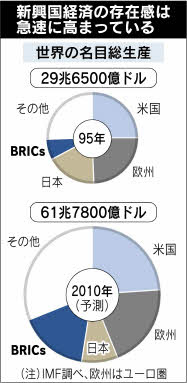
菅改造内閣は円高に有効な策が打てるか(15日、首相官邸を出る野田財務相)
先週初め。財務省の玉木林太郎財務官はパリにいた。円売り介入の数日前。関係者は「一切答えられない」と口を閉ざすが、介入の事前了解を欧米から取り付けるべく動いていた可能性が高い。
13日、スイス・バーゼル。国際決済銀行(BIS)で開かれた主要国中銀総裁会議に白川方明総裁ら日銀首脳が出席していた。首脳らはここでも円高に苦しむ日本の現状を説明した形跡もある。
「協力してくれとは言わないが、黙認してほしい」。政府・日銀関係者と海外当局者の折衝は、介入が日本単独とならざるを得ない厳しい現実を映し出していた。
だが、日本が直面する課題は介入で解決できるほど甘くはない。同じような円高だった15年前と比べても、世界経済の構造変化は著しい。
通貨安競争誘う
国際通貨基金(IMF)によると2010年の世界の名目国内総生産(GDP、ドル換算)のうちBRICs(ブラジル、ロシア、インド、中国)の比率は16%強。1995年に比べて10ポイント近くも増えた。
08年9月のリーマン・ショック後、この傾向は一段と鮮明だ。新興国と対照的に米国は過剰消費のツケ、欧州は金融システム不安、日本は構造的なデフレ圧力にあえぐ。
世界経済の構造が変化するなかで、日本の円売り介入は国際社会の「通貨安競争」を助長するリスクをはらむ。
「あらゆる国にとって為替安定は重要だ」。中国の国営メディアは日本の介入を大きな扱いで報道した。日本に理解を示しつつ、人民元売り・ドル買い介入を正当化する狙いが垣間見えた。
中国だけではない。アジア諸国は自国通貨売り・ドル買い介入を繰り返し、外貨準備が急増している。1年前と比べた6月末残高は中国が15.1%増の2兆4543億ドル、台湾が14.1%増の3624億ドル、韓国が18.3%増の2742億ドル。リーマン・ショック前と比べると、韓国ウォンは日本円に対して46%、人民元は22%も減価した。
「(通貨安)ゲームを黙って観戦しているわけにはいかない」。ブラジルのマンテガ財務相は15日、日本の介入を批判し、レアル高阻止に向け強い決意を示した。
強いドル唱えず
輸出主導で新興国市場を獲得し、リーマン・ショックからの回復を目指す米オバマ政権は、15年前に当時のルービン財務長官が唱えたような「強いドル」をもはや口にしない。日本が介入した翌16日の米下院歳入委員会公聴会。「対等な競争環境をどうやって確保するか。中国だけの問題ではない」。ガイトナー現財務長官は強調した。
「近隣諸国に配慮した政策協調と通貨切り下げの抑制」。09年4月、20カ国・地域(G20)首脳会議の声明はこううたった。だが、いまの世界はG20声明とは異なる方向に動くリスクを抱えているようにみえる。
今回の日本の介入はそんな世界のリアリズムに呼応し、円高とデフレの負の相乗効果に歯止めをかけたとの評価もある。だが、「介入は一時しのぎ。成長力を引き上げる政策こそが重要だ」と日銀関係者は言う。
法人税制の見直し、サービス業の規制緩和・生産性向上、新規ビジネスの育成……。必要な施策を巡る議論は出尽くしている。後は、いつ何を実行するか。17日に発足した菅直人改造内閣が手をこまぬいていれば、市場は政権の本気度を再び試す動きに出るに相違ない。
source: nikkei
.

菅改造内閣は円高に有効な策が打てるか(15日、首相官邸を出る野田財務相)
先週初め。財務省の玉木林太郎財務官はパリにいた。円売り介入の数日前。関係者は「一切答えられない」と口を閉ざすが、介入の事前了解を欧米から取り付けるべく動いていた可能性が高い。
13日、スイス・バーゼル。国際決済銀行(BIS)で開かれた主要国中銀総裁会議に白川方明総裁ら日銀首脳が出席していた。首脳らはここでも円高に苦しむ日本の現状を説明した形跡もある。
「協力してくれとは言わないが、黙認してほしい」。政府・日銀関係者と海外当局者の折衝は、介入が日本単独とならざるを得ない厳しい現実を映し出していた。
だが、日本が直面する課題は介入で解決できるほど甘くはない。同じような円高だった15年前と比べても、世界経済の構造変化は著しい。
通貨安競争誘う
国際通貨基金(IMF)によると2010年の世界の名目国内総生産(GDP、ドル換算)のうちBRICs(ブラジル、ロシア、インド、中国)の比率は16%強。1995年に比べて10ポイント近くも増えた。
08年9月のリーマン・ショック後、この傾向は一段と鮮明だ。新興国と対照的に米国は過剰消費のツケ、欧州は金融システム不安、日本は構造的なデフレ圧力にあえぐ。
世界経済の構造が変化するなかで、日本の円売り介入は国際社会の「通貨安競争」を助長するリスクをはらむ。
「あらゆる国にとって為替安定は重要だ」。中国の国営メディアは日本の介入を大きな扱いで報道した。日本に理解を示しつつ、人民元売り・ドル買い介入を正当化する狙いが垣間見えた。
中国だけではない。アジア諸国は自国通貨売り・ドル買い介入を繰り返し、外貨準備が急増している。1年前と比べた6月末残高は中国が15.1%増の2兆4543億ドル、台湾が14.1%増の3624億ドル、韓国が18.3%増の2742億ドル。リーマン・ショック前と比べると、韓国ウォンは日本円に対して46%、人民元は22%も減価した。
「(通貨安)ゲームを黙って観戦しているわけにはいかない」。ブラジルのマンテガ財務相は15日、日本の介入を批判し、レアル高阻止に向け強い決意を示した。
強いドル唱えず
輸出主導で新興国市場を獲得し、リーマン・ショックからの回復を目指す米オバマ政権は、15年前に当時のルービン財務長官が唱えたような「強いドル」をもはや口にしない。日本が介入した翌16日の米下院歳入委員会公聴会。「対等な競争環境をどうやって確保するか。中国だけの問題ではない」。ガイトナー現財務長官は強調した。
「近隣諸国に配慮した政策協調と通貨切り下げの抑制」。09年4月、20カ国・地域(G20)首脳会議の声明はこううたった。だが、いまの世界はG20声明とは異なる方向に動くリスクを抱えているようにみえる。
今回の日本の介入はそんな世界のリアリズムに呼応し、円高とデフレの負の相乗効果に歯止めをかけたとの評価もある。だが、「介入は一時しのぎ。成長力を引き上げる政策こそが重要だ」と日銀関係者は言う。
法人税制の見直し、サービス業の規制緩和・生産性向上、新規ビジネスの育成……。必要な施策を巡る議論は出尽くしている。後は、いつ何を実行するか。17日に発足した菅直人改造内閣が手をこまぬいていれば、市場は政権の本気度を再び試す動きに出るに相違ない。
source: nikkei
.
Wall Street’s Profit Engines Slow Down
September 19, 2010
By NELSON D. SCHWARTZ
Inside the great investment houses on Wall Street, business has taken a surprising turn — downward.
Even after taxpayer bailouts restored bankers’ profits and pay, the great Wall Street money machine is decelerating. Big financial institutions, including commercial banks, are still making a lot of money. But given unease in the financial markets and the economy, brokerages and investment banks are not making nearly as much as their executives, employees and investors had hoped.
After an unusually sharp slowdown in trading this summer, analysts are rethinking their profit forecasts for 2010.
The activities at the heart of what Wall Street does — selling and trading stocks and bonds, and advising on mergers — are running at levels well below where they were at this point last year, said Meredith Whitney, a bank analyst who was among the first to warn of the subprime mortgage disaster and its impact on big banks.
Worldwide, the number of stock offerings is down 15 percent from this time last year, while bond issuance is off 25 percent, according to Capital IQ, a research firm. Based on these trends, Ms. Whitney predicts that annual revenue from Wall Street’s main businesses will drop 25 percent, to around $42 billion in 2010, from $56 billion last year.
While the numbers will not be known until after the third quarter ends and financial companies begin reporting earnings in October, the pace of trading this summer was slow even by normal summer standards. Trading in shares listed on the New York Stock Exchange was down by 11 percent in July from 2009 levels, and August volume was off nearly 30 percent.
“What’s happened in the third quarter is that after a very slow summer, people expected things to come back,” said Ms. Whitney. “But they haven’t, and the inactivity is really squeezing everyone.”
The downward slide on Wall Street parallels a similar shift in the broader economy, which has slowed considerably since showing signs of a nascent recovery this spring. And if banks come under pressure, all but the safest borrowers may struggle to get loans.
With less than two weeks to go in the third quarter, companies will be hard-pressed to fulfill earlier, more optimistic expectations.
“It’s like the marathon: if you’re five miles behind, you can’t make that up in the last 10 minutes of the race,” said David H. Ellison, president of FBR Fund Advisers, a money management firm that specializes in financial companies. Many banks are barely scraping by in traditional Wall Street business.
As a result, executives, portfolio managers and analysts say that even the mighty Goldman Sachs, which posted a profit every day for the first three months of the year, is unlikely to deliver the kind of profit growth that investors have come to expect.
Keith Horowitz, a bank analyst at Citigroup, said he expected Goldman Sachs to earn $7.8 billion in 2010, a 35 percent decline from the $12.1 billion it made last year.
The drop in trading translates into lower commissions for brokerage firms, as well as a weaker environment for underwriting initial public offerings and other stock issues, traditionally a highly lucrative niche.
Banks are also scaling back on making bets with their own money — known as proprietary trading — another huge profit source in recent years that will soon be forbidden under terms of the financial reform legislation passed by Congress this summer.
Indeed, analysts have finally started to bring their forecasts in line with the new reality. On Sept. 12, Mr. Horowitz reduced his estimates for third-quarter profits at Goldman and Morgan Stanley.
Mr. Horowitz had predicted Goldman would make $1.75 billion in the third quarter, or $3 a share; he now expects Goldman’s profit to total $1.34 billion, or $2.30 a share. For Morgan Stanley, his revision was even steeper, with earnings expectations revised downward to $140 million, or 10 cents a share, from $726 million, or 53 cents a share.
Mr. Horowitz’s estimates are considerably lower than the consensus among analysts who track the two companies. If the other analysts revise their estimates closer to his, they would put pressure on the shares.
One of the rare bright spots for Wall Street recently has been the issuance of junk bonds, as ultra-low interest rates encourage investors to seek out riskier debt that carries a higher yield. But that will not be enough to offset the weakness elsewhere, said one top Wall Street executive who insisted on anonymity because he was not authorized to speak publicly for his company, and because final numbers would not be tallied until the end of the month.
To make matters worse, he said, many Wall Street firms increased their work forces in the first half of the year, before the mood shifted and worries of a double-dip recession arose. If activity remains anemic, firms could soon begin cutting jobs again.
“I think the summer was horrible for everyone, and no one expected it to be as bad as it was,” he said. “It’s coming back a little bit in September but nowhere near enough to make up for what happened in July and August.”
The profit picture is brighter for diversified companies like JPMorgan Chase and Bank of America, which have larger commercial and retail banking operations in addition to their Wall Street units, but some analysts say earnings expectations for them could come down as well.
“Estimates still seem a little high, and the revenue story for all the banks is not a good one,” said Ed Najarian, who tracks the banking sector for ISI, a New York research firm.
With interest rates plunging, banks are making less off their interest-earning assets like government bonds and other ultra-safe securities. At the same time, demand for new loans remains weak.
One wild card will be the credit card portfolios at major banks like JPMorgan, Bank of America and Citigroup. As delinquencies ease, Mr. Najarian said, credit losses are likely to decline. That trend helped earnings at JPMorgan in the second quarter, and could be crucial again in the third quarter.
Ms. Whitney says the gloomy short-term predictions foreshadow a series of lean years in the broader financial services industry.
Indeed, she said the Street faced a “resizing” not seen since the cutbacks that followed the bursting of the dot-com bubble a decade ago.
“We expect compensation to be down dramatically this year,” she wrote in a recent report. She predicts the American banking industry will lay off 40,000 to 80,000 employees, or as many as 1 in 10 of its workers.
That may be extreme, but Ms. Whitney argues that the boom years are not coming back anytime soon. As both consumers and companies cut back on debt, and financial reform rules put the brakes on profitable niches like derivatives and proprietary trading, the engines of earnings growth for the last decade will continue to sputter.
By NELSON D. SCHWARTZ
Inside the great investment houses on Wall Street, business has taken a surprising turn — downward.
Even after taxpayer bailouts restored bankers’ profits and pay, the great Wall Street money machine is decelerating. Big financial institutions, including commercial banks, are still making a lot of money. But given unease in the financial markets and the economy, brokerages and investment banks are not making nearly as much as their executives, employees and investors had hoped.
After an unusually sharp slowdown in trading this summer, analysts are rethinking their profit forecasts for 2010.
The activities at the heart of what Wall Street does — selling and trading stocks and bonds, and advising on mergers — are running at levels well below where they were at this point last year, said Meredith Whitney, a bank analyst who was among the first to warn of the subprime mortgage disaster and its impact on big banks.
Worldwide, the number of stock offerings is down 15 percent from this time last year, while bond issuance is off 25 percent, according to Capital IQ, a research firm. Based on these trends, Ms. Whitney predicts that annual revenue from Wall Street’s main businesses will drop 25 percent, to around $42 billion in 2010, from $56 billion last year.
While the numbers will not be known until after the third quarter ends and financial companies begin reporting earnings in October, the pace of trading this summer was slow even by normal summer standards. Trading in shares listed on the New York Stock Exchange was down by 11 percent in July from 2009 levels, and August volume was off nearly 30 percent.
“What’s happened in the third quarter is that after a very slow summer, people expected things to come back,” said Ms. Whitney. “But they haven’t, and the inactivity is really squeezing everyone.”
The downward slide on Wall Street parallels a similar shift in the broader economy, which has slowed considerably since showing signs of a nascent recovery this spring. And if banks come under pressure, all but the safest borrowers may struggle to get loans.
With less than two weeks to go in the third quarter, companies will be hard-pressed to fulfill earlier, more optimistic expectations.
“It’s like the marathon: if you’re five miles behind, you can’t make that up in the last 10 minutes of the race,” said David H. Ellison, president of FBR Fund Advisers, a money management firm that specializes in financial companies. Many banks are barely scraping by in traditional Wall Street business.
As a result, executives, portfolio managers and analysts say that even the mighty Goldman Sachs, which posted a profit every day for the first three months of the year, is unlikely to deliver the kind of profit growth that investors have come to expect.
Keith Horowitz, a bank analyst at Citigroup, said he expected Goldman Sachs to earn $7.8 billion in 2010, a 35 percent decline from the $12.1 billion it made last year.
The drop in trading translates into lower commissions for brokerage firms, as well as a weaker environment for underwriting initial public offerings and other stock issues, traditionally a highly lucrative niche.
Banks are also scaling back on making bets with their own money — known as proprietary trading — another huge profit source in recent years that will soon be forbidden under terms of the financial reform legislation passed by Congress this summer.
Indeed, analysts have finally started to bring their forecasts in line with the new reality. On Sept. 12, Mr. Horowitz reduced his estimates for third-quarter profits at Goldman and Morgan Stanley.
Mr. Horowitz had predicted Goldman would make $1.75 billion in the third quarter, or $3 a share; he now expects Goldman’s profit to total $1.34 billion, or $2.30 a share. For Morgan Stanley, his revision was even steeper, with earnings expectations revised downward to $140 million, or 10 cents a share, from $726 million, or 53 cents a share.
Mr. Horowitz’s estimates are considerably lower than the consensus among analysts who track the two companies. If the other analysts revise their estimates closer to his, they would put pressure on the shares.
One of the rare bright spots for Wall Street recently has been the issuance of junk bonds, as ultra-low interest rates encourage investors to seek out riskier debt that carries a higher yield. But that will not be enough to offset the weakness elsewhere, said one top Wall Street executive who insisted on anonymity because he was not authorized to speak publicly for his company, and because final numbers would not be tallied until the end of the month.
To make matters worse, he said, many Wall Street firms increased their work forces in the first half of the year, before the mood shifted and worries of a double-dip recession arose. If activity remains anemic, firms could soon begin cutting jobs again.
“I think the summer was horrible for everyone, and no one expected it to be as bad as it was,” he said. “It’s coming back a little bit in September but nowhere near enough to make up for what happened in July and August.”
The profit picture is brighter for diversified companies like JPMorgan Chase and Bank of America, which have larger commercial and retail banking operations in addition to their Wall Street units, but some analysts say earnings expectations for them could come down as well.
“Estimates still seem a little high, and the revenue story for all the banks is not a good one,” said Ed Najarian, who tracks the banking sector for ISI, a New York research firm.
With interest rates plunging, banks are making less off their interest-earning assets like government bonds and other ultra-safe securities. At the same time, demand for new loans remains weak.
One wild card will be the credit card portfolios at major banks like JPMorgan, Bank of America and Citigroup. As delinquencies ease, Mr. Najarian said, credit losses are likely to decline. That trend helped earnings at JPMorgan in the second quarter, and could be crucial again in the third quarter.
Ms. Whitney says the gloomy short-term predictions foreshadow a series of lean years in the broader financial services industry.
Indeed, she said the Street faced a “resizing” not seen since the cutbacks that followed the bursting of the dot-com bubble a decade ago.
“We expect compensation to be down dramatically this year,” she wrote in a recent report. She predicts the American banking industry will lay off 40,000 to 80,000 employees, or as many as 1 in 10 of its workers.
That may be extreme, but Ms. Whitney argues that the boom years are not coming back anytime soon. As both consumers and companies cut back on debt, and financial reform rules put the brakes on profitable niches like derivatives and proprietary trading, the engines of earnings growth for the last decade will continue to sputter.
19/09 Just Manic Enough: Seeking Perfect Entrepreneurs
 Matthew Cavanaugh for The New York Times
Seth Priebatsch’s passionate pitch won over investors for his latest start-up.
September 18, 2010
By DAVID SEGAL
Cambridge, Mass.
IMAGINE you are a venture capitalist. One day a man comes to you and says, “I want to build the game layer on top of the world.”
 Matthew Cavanaugh for The New York Times
“You need to suspend disbelief to start a company,” says the investor Paul Maeder. “So many people will tell you that what you’re doing can’t be done.”
You don’t know what “the game layer” is, let alone whether it should be built atop the world. But he has a passionate speech about a business plan, conceived when he was a college freshman, that he says will change the planet — making it more entertaining, more engaging, and giving humans a new way to interact with businesses and one another.
If you give him $750,000, he says, you can have a stake in what he believes will be a $1-billion-a-year company.
Interested? Before you answer, consider that the man displays many of the symptoms of a person having what psychologists call a hypomanic episode. According to the Diagnostic and Statistical Manual — the occupation’s bible of mental disorders — these symptoms include grandiosity, an elevated and expansive mood, racing thoughts and little need for sleep.
“Elevated” hardly describes this guy. To keep the pace of his thoughts and conversation at manageable levels, he runs on a track every morning until he literally collapses. He can work 96 hours in a row. He plans to live in his office, crashing in a sleeping bag. He describes anything that distracts him and his future colleagues, even for minutes, as “evil.”
He is 21 years old.
So, what do you give this guy — a big check or the phone number of a really good shrink? If he is Seth Priebatsch and you are Highland Capital Partners, a venture capital firm in Lexington, Mass., the answer is a big check.
But this thought exercise hints at a truth: a thin line separates the temperament of a promising entrepreneur from a person who could use, as they say in psychiatry, a little help. Academics and hiring consultants say that many successful entrepreneurs have qualities and quirks that, if poured into their psyches in greater ratios, would qualify as full-on mental illness.
Which is not to suggest that entrepreneurs like Seth Priebatsch (pronounced PREE-batch) are crazy. It would be more accurate to describe them as just crazy enough.
“It’s about degrees,” says John D. Gartner, a psychologist and author of “The Hypomanic Edge.” “If you’re manic, you think you’re Jesus. If you’re hypomanic, you think you are God’s gift to technology investing.”
The attributes that make great entrepreneurs, the experts say, are common in certain manias, though in milder forms and harnessed in ways that are hugely productive. Instead of recklessness, the entrepreneur loves risk. Instead of delusions, the entrepreneur imagines a product that sounds so compelling that it inspires people to bet their careers, or a lot of money, on something that doesn’t exist and may never sell.
So venture capitalists spend a lot of time plumbing the psyches of the people in whom they might invest. It’s not so much about separating the loonies from the slightly manic. It’s more about determining which hypomanics are too arrogant and obnoxious — traits common to the type — and which have some humanity and interpersonal skills, always helpful for recruiting talent and raising money.
Some V.C.’s have personality tests to help them weed out the former. Others emphasize their toleration of mild forms of mania, if only because starting a business is, on its face, a little nuts.
“You need to suspend disbelief to start a company, because so many people will tell you that what you’re doing can’t be done, and if it could be done, someone would have done it already,” says Paul Maeder, a general partner at Highland Capital. “There are six billion human beings on this planet, we’ve been around for hundreds of thousands of years, we’re a couple hundred years into the industrial revolution — and nobody has done what you want to do? It’s kind of crazy.”
ON a recent Saturday evening, Seth Priebatsch is sitting in his office/bedroom in the 26,000-square-foot space that houses Scvngr (pronounced “scavenger”), which he founded in early 2009. Dozens of toy race cars fill a bookshelf on one wall; the other is covered with lists and drawings. The sofa where he crashes in his sleeping bag lies between the two.
He will explain the genesis of Scvngr, and offer a sort of guided tour of his mind, while sitting on a stool in his bare feet, wearing jeans and a Princeton T-shirt. A pair of Oakley sunglasses are perched, as they nearly always are, atop his head — part talisman, part personal branding.
He is lean, smiley and partial to the word “awesome,” which he uses as a noun — as in “an extra dose of awesome.” He speaks quickly and with what sounds like a Canadian accent, which seems odd because he was raised in Boston.
He first pitched Scvngr as a freshman at Princeton, to a professor linked to an annual business plan contest open to undergraduates and graduates. “I told him I wanted to build the game layer on top of the world,” Mr. Priebatsch recalls. “And he didn’t say, ‘You’re insane.’ So I said, ‘And I want everyone in the world to help me build it.’”
Scvngr won first prize, which came with $5,000 and emboldened him to apply to a seed financing company, DreamIt Ventures, which gave him $35,000. The victory also caught the eye of a venture capitalist, Peter Bell of Highland Capital, who read about Mr. Priebatsch’s prize while surfing the Web one night. Mr. Bell popped off an e-mail.
“It was Saturday night, pretty late,” Mr. Bell recalls. “I said, ‘If you ever come to Boston, I’d love to meet you.’”
Mr. Priebatsch replied immediately: he’d decided to drop out of Princeton and move to Boston. The university would be around a long time, he reasoned, but the moment to start Scvngr was fleeting and couldn’t wait a few weeks, let alone three years.
So, what is this potentially globe-altering enterprise?
“Scvngr is a game that you play on your phone, and playing Scvngr is incredibly easy,” he begins.
The game allows you to compete and win rewards at stores, gyms, theaters, museums and so on. A Mexican restaurant, for instance, might offer half off your next soda if you fold the tin foil on your burrito into origami, then snap a picture of it.
If this sounds like little more than a gimmicky way to lure in consumers, well, you haven’t listened to Mr. Priebatsch long enough.
“We play games all the time, right?” he says. “School is a game. It’s just a very badly designed game.” American Express cards, with their escalating status, from green, to gold to black — they are a game. So are frequent-flier miles.
“But game dynamics aren’t consciously leveraged in any meaningful way, and Scvngr does that.”
This, apparently, has enormous implications. “If we can bring game dynamics to the world, the world will be more fun, more rewarding, we’ll be more connected to our friends, people will change their behavior to be better. But if this is going to work it has to be something that anyone can play and that everyone can build.”
This, he says, is the key: Scvngr is both a game and a game platform. Anyone can create a Scvngr challenge, free, using four default games or tools the company offers. There are now 20 million Scvngr challenges in the United States, according to the company, most of which are simple tasks, like “stand in this spot and say something.”
In addition, about 1,000 companies and organizations — including the New England Patriots, Zipcar, Sony and Warner Brothers — pay Scvngr to create and manage their challenges.
“The last decade was the decade where the social framework was built,” he says — most successfully by Facebook. “The next decade will be the decade of games.”
Judging this pitch by reading it, as opposed to hearing it in person, is like appraising a song based solely on its lyrics. Mr. Priebatsch describes Scvngr and the future it portends with burbling fluency, as if it were a country he has visited and one that you must see. He is especially good at giving “the game layer” an aura of inevitability.
It is hardly clear, though, that such a layer will catch on or, if it does, whether Scvngr will be the company to build it. The field of location-based tech games is crowded, and include standouts like Foursquare and Gowalla.
The particulars of Scvngr seem nitpickable, too. The game’s points will earn you whatever goodie is offered on the spot, but there is nothing else you can do with them. And some users have found Scvngr’s challenges to be pretty lame. More than a few of the contests seem like barely veiled marketing ploys — like retailers that “challenge” you to come up with three words that describe the store.
Reviews so far have split the crowd. As of last week, a third of the roughly 1,000 people who had weighed in on the latest version of Scvngr in the iPhone’s App Store gave it the highest rating and one-third gave it the lowest.
“Not relevant to having fun,” read one review.
But Mr. Priebatsch’s pitch has worked, at least by the standards of start-ups, most of which die in the blueprint phase. Part of the reason could be pinned on the investing and tech world’s raging case of Next Zuckerberg Syndrome — the urge to find another Mark Zuckerberg before he starts another Facebook.
But nobody inspires N.Z.S. without a promising idea, intelligence and a lot of charisma. Scvngr today has 60 employees, many of them veterans of very successful tech start-ups. As of December of last year, it also had $4 million from Google Ventures.
Any list of the qualities that have netted all this talent and money should include Mr. Priebatsch’s quasirobotic work ethic. He does not socialize. He no longer reads books, nor does he watch TV or movies. He works from 8 a.m. until 10 p.m., seven days a week. He was reluctant to have a photographer visit for this article because he worried that it might distract employees.
Doesn’t he miss going to bars, just hanging out, being 21? Here’s where Mr. Priebatsch starts to sound like a teenage Vulcan.
“I had friends at Princeton; I’m sure it’d be fun to see them,” he says. “But I know that what I’m going after is huge and others are going after it, and if they’re not, they’re making a mistake. But other people will figure it out, and every minute that I’m not working on it is a minute when they’re making progress and I’m not. And that is just not O.K.”
THE hypomanic temperament is, of course, not limited to entrepreneurs. It’s found in politics (Theodore Roosevelt) the military (George S. Patton), Hollywood (the studio head David O. Selznick) and virtually any field where outsize risks yield enormous rewards.
But the business world has contributed more than its share of hypomanics, particularly the abusive, ornery kind. The most colorful of the breed was arguably Henry Ford.
“He epitomizes the unhinged, entrepreneurial spirit,” says Douglas G. Brinkley, a history professor at Rice University and author of “Wheels for the World,” a book about Mr. Ford and his company. “He became monomaniacal in his belief that the internal combustion engine should be fueled by gas, at a time when everything was electric, and nobody thought you could put gas on a hot motor.”
Mr. Ford could be both charmer and ruthless jerk. When he visited rural America to extol the horseless carriage, listeners were often left hoping that he would run for president. With employees, on the other hand, he was an autocrat who never brooked dissent. He clung so stubbornly to his vision — black cars, and only black cars, for the masses — that the company almost went bust when rivals like General Motors started offering more choices.
Nearly all conversations about contemporary hypomanics start with the Apple chief executive, Steven P. Jobs. Like Mr. Ford, he is a pitchman extraordinaire with a vaguely messianic streak, and, like Mr. Ford, he can anticipate what people will want before they even know they want it.
Mr. Jobs is also routinely described as a despot and control freak with a terrifying temper, says Leander Kahney, author of “Inside Steve’s Brain.”
“Even the prospect of a chewing out by Steve Jobs makes people work 90 hours a week,” says Mr. Kahney. He treats employees as tools, Mr. Kahney went on, as a means to an end, with the end defined as a universe of Apple products and services that are tailored precisely to his specifications.
“I would argue that Jobs has used his control freakery to advantage,” Mr. Kahney says. “The hallmark of Apple is the way it controls the entire user experience — the ads, the stores, the iPods. Nothing is left to chance. That comes from Steve Jobs.”
Scholars in organizational studies tend to divide the world into “transformational leaders” (the group that hypomanics are bunched into, of course) and “transactional leaders,” who are essentially even-keeled managers, grown-ups who know how to delegate, listen and set achievable goals.
Both types of leaders need to rally employees to their cause, but entrepreneurs must recruit and galvanize when a company is little more than a whisper of a big idea. Shouting “To the ramparts!” with no ramparts in sight takes a kind of irrational self-confidence, which is perfectly acceptable, though it can also tilt into egomania, which is usually not.
“We have a grid personality scorecard, across 10 or 12 dimensions, attributes that are critical to success,” says Michael A. Greeley, a general partner at Flybridge Capital Partners in Boston.
The goal is to spot the really erratic characters, whom Mr. Greeley calls “rail to rail”:
“One day they get up and their favorite color is pink. The next day, it’s green. I’ve worked with hypomanics, and where I think it can be quite insidious — people like this turn on colleagues quickly. An employee could be an incredible contributor, and then, after one mistake, they are out of the lifeboat.”
BEFORE Highland Capital invested in Scvngr, Peter Bell gave Seth Priebatsch’s life and résumé the vigorous frisking that is standard in the venture capital business.
Mr. Priebatsch was 19 at the time, which meant that he didn’t have a lot of former colleagues or bosses. What he did have, however, was a surprisingly long track record in business.
Scvngr is actually the third company that Mr. Priebatsch has founded. At the age of 12, with money from his parents, he started Giftopedia, a price-comparison shopping Web site. When he was in eighth grade, the company had eight employees — six in India, two in Russia.
Nobody who worked for him ever asked him his age, and he never volunteered it. “I wouldn’t say that I kept my age a secret,” he says. “I just never offered that information. Nobody knows how old you are on the Internet.”
All communications were handled via e-mail and Skype, often while he was typing on a laptop while sitting in class. For a long time, his teachers thought that he was simply taking copious notes, but he was actually sending instructions overseas with a wireless connection.
“One day, I forgot to hit the mute button on my laptop and it started ringing during French class,” he recalls. The Giftopedia server was down that day, and it was a crisis.
“I got up and told my teacher, ‘I’m really sorry, but I have to take this call.’ ”
Giftopedia was profitable, but a little late to the field, Mr. Priebatsch says. Ultimately, he sold the domain name for five figures and, at 17, founded PostcardTech, which created and mailed out promotional mini-CDs on behalf of tourist destinations and universities. For that company, he rented part of a factory in China, which, he said, was time-consuming but surprisingly easy and didn’t even require a trip to Asia.
Mr. Priebatsch handed PostcardTech off to some friends, who did little with it, and the company has since folded. But it left Mr. Priebatsch with a chunk of money — he won’t say how large — that he has since invested in Scvngr.
Dr. Gartner, the author and psychologist, says he believes that hypomanics come by their disposition genetically. But it is hard to tease out what Norman and Suzanne Priebatsch — a biotech entrepreneur and a financial adviser at SmithBarney, respectively — bequeathed through their DNA and what they instilled in Seth and his older sister, Daniella Priebatsch, as they grew up.
Because chez Priebatsch sounds like boot camp for the brain.
“With both my kids, my wife and I pushed them very hard,” says Norman Priebatsch, who is a native of South Africa. “Very invasive, very intrusive, doing things, planning things continuously.”
As a child, when Seth started to read along with his father — high-level math, physics and history books were the staples — the elder Mr. Priebatsch would often turn the books upside down, adding a degree of difficulty to the experience, and presumably some fun.
The upshot is that Seth can now read as quickly upside down as right-side up, something to keep in mind if you ever find yourself sitting across a desk from him.
“People assume that if you’ve got a sheet of paper in front of you that no one else can read it,” he says, “and that is false.”
Vacations, Seth says, made school seem relaxing. He and his sister were expected to research destinations — Istanbul, Shanghai and Rome, for instance — and then plan most of the itinerary down to the hour. On the trips, they would tour all day and night, leaving time for the children to upload photos to a laptop and type up a detailed account of everything they’d seen.
“We were the scribes of those trips; that was a requirement,” says Daniella, who now works on a sales team at Google. “Every detail — what it was like at the museum, people we met. Even the room number of the hotel, in case it was a good room and we ever came back.”
The rigor and intensity of Seth’s upbringing have left him with a peculiar combination of rarefied skills and mundane deficiencies. He is a gifted software engineer but a terrible driver. (“I hit things,” he says.) He’s perfectly at ease negotiating with V.C.’s, but has had just one girlfriend, a relationship that ended abruptly when someone asked how long they’d been dating.
“We answered simultaneously and she said six months and I said two weeks,” he recounts, sounding amused. “Two weeks earlier we’d had this conversation, and I said, ‘And so now we’re dating, correct?’ And she said yes.”
He shrugs.
“I thought I’d been really clear,” he says. “I find business relationships are easier. You have to sign a piece of paper.”
IN late 2008, as part of the investment process, Mr. Priebatsch had to visit Highland Capital’s offices and present his plan to the firm’s partners.
It went well, but there are still skeptics at the firm. Mr. Maeder of Highland still wonders whether Scvngr is the scaffolding of a major business. At the same time, he regards the $750,000 investment as a bet on Mr. Priebatsch as much as a bet on his company.
“Seth has such a fertile mind; you just know that he’ll attract great people to the company,” he says, “and the ideas will continue to flow and morph until he finds something great.”
You also get the sense that Mr. Priebatsch won’t stop, even if Scvngr is a glorious triumph.
“I like winning,” he says. “I’m addicted to the act of winning, the process. When you are in the act of winning, everything is great. Once you’ve won, that’s boring. It’s cool, it’s better than having lost, but it’s boring.”
Great piles of money would not slow him down, either.
“I’m not anti-money,” he says. “I like nice bikes, I like nice computers. I like that money is a representation of success, but the actual entity itself is not interesting for me. There is little that I would want that I don’t have, and the things that I want money can’t buy.”
Like?
He doesn’t pause.
“I want to build the game layer on top of the world.”
20090919 働きやすい会社2010、ソニーが初の首位-新人の特性に合わせ研修
本社調査
日本経済新聞社は19日、主要企業を対象に実施した2010年の「働きやすい会社」調査の結果をまとめた。ソニーが初めて総合ランキングの首位になった。2位の東芝をはじめ上位10位のうち電機が6社を占めた。グローバル人材の育成など時代に即した社員教育を充実させた企業や、育児・介護に配慮し多様な働き方の実現に取り組む企業が高い評価を得た。=企業ランキングと調査結果の詳細を21日付日経産業新聞に

働きやすい会社調査は日経リサーチとの共同企画で、企業の人事・労務制度の充実度を点数化し、ビジネスパーソンが重視する度合いに応じて傾斜配分してランキングを作成した。4つの項目別ランキングも作った。
総合1位のソニーは「社員の意欲を向上させる制度」の項目でトップだったほか「働く側に配慮した職場づくり」で東芝に次ぐ2位に入った。
ソニーは今春から新入社員とチューターの教育に、米海兵隊で使われている組織論「FSS理論」を導入した。
「部下を放任する」「細かく指導する」など社員を行動パターンで類型化し、1つのチームに様々なタイプを組み合わることで生産性を上げる理論で「新人の特性に合った適切な指導が可能になった」(人事企画部)。
社員1人あたりの研修費が36万8988円と1位だった点や、10月を「キャリア月間」に位置付け、社員の意欲を引き出していることも高評価につながった。
年休制度の利用 東芝、要件緩和
2位の東芝は「働く側に配慮した職場づくり」「子育てに配慮した職場づくり」の2つの項目で最多得点を獲得し、昨年の18位から躍進した。今年4月から最低1時間から取得できる年休制度の利用要件を緩和し、使い勝手を向上させた。
パナソニックは昨年1位から3位に後退したが、4つの項目すべてで4位以内に入った。今年3月までの2年間で育児休業を取得した男性社員は1386人と、日産自動車に次ぐ2位だった。
日立製作所は留学機会を提供
4位の日立製作所は「今後2年半の間に2000人の意欲ある若手社員に海外業務研修や留学の機会を提供する」、5位の凸版印刷は「本社と関連会社の垣根を取り払いグループ全体で人材を育成する」(凸版印刷)と回答。時代の変化に即して社員の成長を後押しする姿勢を示した。
日本経済新聞社は19日、主要企業を対象に実施した2010年の「働きやすい会社」調査の結果をまとめた。ソニーが初めて総合ランキングの首位になった。2位の東芝をはじめ上位10位のうち電機が6社を占めた。グローバル人材の育成など時代に即した社員教育を充実させた企業や、育児・介護に配慮し多様な働き方の実現に取り組む企業が高い評価を得た。=企業ランキングと調査結果の詳細を21日付日経産業新聞に

働きやすい会社調査は日経リサーチとの共同企画で、企業の人事・労務制度の充実度を点数化し、ビジネスパーソンが重視する度合いに応じて傾斜配分してランキングを作成した。4つの項目別ランキングも作った。
総合1位のソニーは「社員の意欲を向上させる制度」の項目でトップだったほか「働く側に配慮した職場づくり」で東芝に次ぐ2位に入った。
ソニーは今春から新入社員とチューターの教育に、米海兵隊で使われている組織論「FSS理論」を導入した。
「部下を放任する」「細かく指導する」など社員を行動パターンで類型化し、1つのチームに様々なタイプを組み合わることで生産性を上げる理論で「新人の特性に合った適切な指導が可能になった」(人事企画部)。
社員1人あたりの研修費が36万8988円と1位だった点や、10月を「キャリア月間」に位置付け、社員の意欲を引き出していることも高評価につながった。
年休制度の利用 東芝、要件緩和
2位の東芝は「働く側に配慮した職場づくり」「子育てに配慮した職場づくり」の2つの項目で最多得点を獲得し、昨年の18位から躍進した。今年4月から最低1時間から取得できる年休制度の利用要件を緩和し、使い勝手を向上させた。
パナソニックは昨年1位から3位に後退したが、4つの項目すべてで4位以内に入った。今年3月までの2年間で育児休業を取得した男性社員は1386人と、日産自動車に次ぐ2位だった。
日立製作所は留学機会を提供
4位の日立製作所は「今後2年半の間に2000人の意欲ある若手社員に海外業務研修や留学の機会を提供する」、5位の凸版印刷は「本社と関連会社の垣根を取り払いグループ全体で人材を育成する」(凸版印刷)と回答。時代の変化に即して社員の成長を後押しする姿勢を示した。
20100919 nikkei: (上)立ち上がる6億人市場 - 中間層拡大 消費に熱気

【ジャカルタ=野沢康二】東南アジア諸国連合()が新たな成長期を迎えた。金融危機からいち早く立ち直り、6億人規模の域内市場は所得の底上げによる中間層の拡大で消費ブームに沸く。中国、インドという巨大な隣人に挟まれながらも、自由貿易協定(FTA)などをテコに存在感を発揮。消費市場に加え生産拠点として内外需のかみ合った発展を探るASEANに、域外国も熱い視線を送る。
中間層の拡大が消費をけん引(ジャカルタ)

「大きめの車種への買い替え需要が多い」。インドネシア・ジャカルタ郊外に先月オープンしたばかりの日産自動車の販売店でアンドレ・アダム店長がこう話す。8月の売り上げは目標の2割増し。日産は現在40強の販売拠点を2013年までに80カ所に増やす。
1~7月の同国新車販売は前年同期より75%増えた。成長を見込み、1990年代に撤退した米クライスラーが再参入。中国の浙江吉利控股集団や韓国の現代自動車が相次ぎ現地生産を開始し、中国の北京汽車工業のグループ会社も来年から小型乗用車生産を始める。
ASEANで自動車販売は絶好調だ。市場規模の小さいシンガポールを除く主要5カ国(インドネシア、タイ、マレーシア、フィリピン、ベトナム)の今年1~7月は前年の不振もあり、前年同期比44%増の約138万台。通年では約200万台だった08年を超え、過去最高を更新しそうだ。
原動力は拡大する中間層。みずほ総合研究所などによると、可処分所得5000ドル超の中間層・富裕層人口は08年、ASEAN主要5カ国で約2億600万人。1990年から5倍近くに増えた。中国(4億6000万人)には及ばないが、インド(2億人)と並ぶ。これが20年には3億9000万人近くに膨らむ見通しで、消費市場としての潜在性は大きい。
日本のイオン、英テスコ、仏カジノなどが争奪戦――。仏カルフールのタイ、マレーシア、シンガポール事業の売却を巡り流通大手のつばぜり合いが続く。カルフールは東南アジアではインドネシアに集中、来年から出店ペースをこれまでの年10店程度から同20店に増やす。同業他社はカルフールの売却事業からさらなる成長を狙う。
都市型消費スタイルの広がりでコンビニエンスストアも急拡大。セブンイレブンの5カ国での店舗数は約7200店と05年末の1.7倍だ。現地の一般的な昼食1回分かそれ以上の価格でコーヒーを提供する米スターバックスなども店舗網を広げている。旅行需要の拡大をにらみ航空大手エア・アジアは7月、ASEAN10カ国すべてをつなぐ路線網を完成させた。
アジアの消費文化に詳しいインドネシアの評論家ウィリアム・ウォンソ氏は「東南アジア全域でグルメや健康などのために出費を惜しまない中間層が着実に増えている」と話す。
米プロクター・アンド・ギャンブル(P&G)は東南アジアに適した商品の開発強化へ、13年までにシンガポールに洗顔料などの研究開発拠点を開く。スイスの食品大手ネスレも、インスタントコーヒーの開発部門をスイスからシンガポールに移管した。立ち上がる6億人市場を見据え、ASEAN内外の企業の動きも活発になっている。
source: nikkei
可処分所得[ disposable income ]
個人所得から税と社会保障負担などを差し引いた残りの部分で、個人が自由に処分できる所得。個人の購買力を測る1つの目安となっている。
.
Subscribe to:
Posts (Atom)